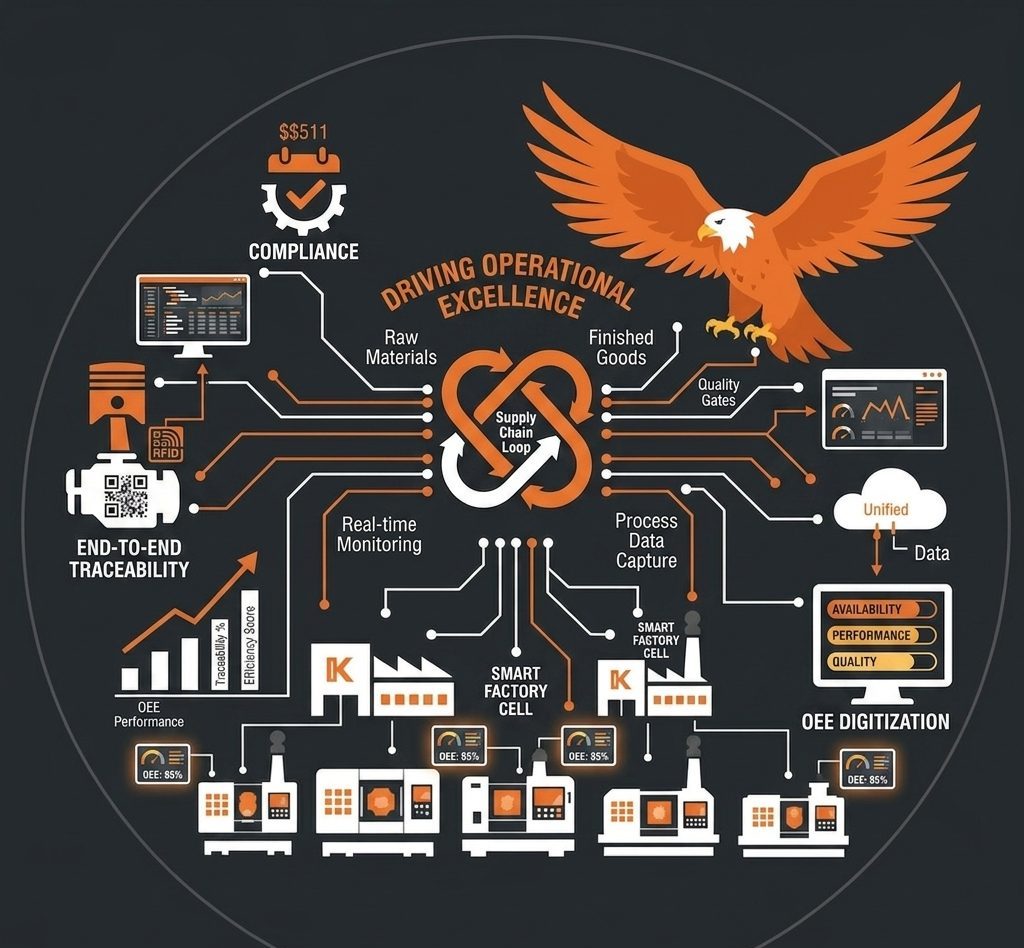
IoT-Driven Traceability and Process Control for Defense-Grade Manufacturing
1. Background:
The project was executed for a high-security manufacturing environment supplying components for defense applications. Such environments demand not only precision and reliability but also strict adherence to safety, confidentiality, and operational resilience standards. Our experience in handling projects governed by defense protocols gave us an edge in designing systems that are both technologically advanced and compliant with restricted-environment regulations.2. Problem Statement:
The production process was traditionally managed through manual, paper-based systems, which posed challenges in tracking and monitoring key operations. Without digitalization, accurate traceability and real-time monitoring were difficult to achieve, leading to quality issues, inefficiencies and potential safety risks. The environment requires all equipment and systems to be flame-proof and meet stringent safety standards due to the nature of the materials and processes involved. Additionally, the client operated within a regulated defense manufacturing framework, which required meticulous process traceability, strict access control, and compliance with safety norms. The absence of a digital system made it difficult to maintain real-time visibility, auditability, and reliability expected in such sensitive setups.3. Our Proposed Solution:
IoT-Enabled Traceability System for Flame-Proof Environments:
Retrofitting: In retrofitting, we connected the client’s existing machines with a PLC and required sensors to enable accurate data collection and integration into our IoT device. To facilitate this, we utilized a Modbus signal converter for the weighing machine, ensuring seamless data transfer. Through this setup, mixing (Mixture 1 & 2) and drying process data were effortlessly captured from and displayed in real time, ensuring precision and reliability. Real-Time Monitoring: We used sfHawk’s Vajra IoT device to track the production process digitally, while keeping everything safe and compliant for flame-proof environments. Data Collection: The new system recorded important production data in real time, such as material weights, mixing, and drying times, reducing the need for manual input or supervision and improving the data accuracy.
4. System Features and Workflow:
Flame-Proofing and Safety Compliance:
- Every machine and sensor was retrofitted to meet strict safety standards, ensuring that the entire environment remained compliant with flame-proof and safety regulations.
- The retrofitting process included the installation of explosion-proof enclosures, intrinsically safe devices, and careful sealing of electrical components to prevent ignition sources.
Weighing Machine:
- Critical Data Entry: The system allowed operators to select compositions, input batch numbers, and validate ingredient weights against expected values.
- Final Data Submission: After the weights were checked, the system allowed the data to be saved in a secure database, keeping records accurate and safe.
Mixture 1 & Mixture 2:
- Pre-populated Data: Ingredients, compositions, and batch numbers were pre-loaded from the Weighing Machine stage, reducing the risk of human error.
- Time Tracking: Both Mixture 1 and Mixture 2 processes included time indicators, which allowed operators to track the duration of mixing and ensure that it adhered to prescribed standards.
- Validation Process: The system was designed to track mixing time and temperature, ensuring that the mixing process follows the expected time fetched from the database. If the process goes beyond the expected time, the system will track it, and the responsible approver will be notified in the reports.
Dryer:
- Operational Data Tracking: The Dryer block displayed real-time data for batch number, composition, and ingredient information, along with temperature and time indicators.
- Manual Control: Operators manually initiated the drying process, but the system continuously monitored and displayed the status, ensuring the drying process remained under control.
5. Outcomes and Benefits:
- Quality Control: Through real-time validation of ingredient weights and adherence to SOPs, the system ensured that production processes met the highest quality standards, minimizing human errors that could compromise product consistency.
- Enhanced Traceability: The system ensured full traceability across all production stages, from weighing to drying. Every action was logged with timestamps, providing an audit trail that could be referenced at any time.
- Scope for future enhancements: This project has laid a strong foundation for advanced improvements in automation and process control. With machines now connected and real-time data readily available, the factory is planning to take the next step to automated machine intervention.
- For instance, if the mixing temperature exceeds the predefined threshold, the system will automatically halt the process to ensure safety and maintain quality. This evolution toward intelligent automation is expected to further enhance operational efficiency, reduce manual dependency, and ensure tighter control over critical production parameters.
- Operational Efficiency: Automating manual data collection and reducing the need for manual interventions significantly improved operational efficiency. The ability to track production in real-time helped identify and resolve issues faster.
6. Conclusion:
This project gave us the experience of working within the rigorous environment of the defense manufacturing sector, where precision, security, and reliability are critical. It helped us understand the unique operational challenges and high standards expected in such setups. Our Industrial Tech 4.0 solution has revolutionized production process in a flame-proof environment by leveraging IoT technology, automation, and real-time data. By retrofitting the entire system to ensure safety in a regulated setting, the solution enhanced quality, traceability and efficiency, while maintaining full compliance with safety standards. The result is a safer, more efficient production process that empowers operators and supervisors to make informed decisions based on accurate, real-time data.
For more Information-
Call: 91120 98351