Is a Manufacturing Monitoring System Useless for SMEs?

27 Jan, 2026

    A Common Misconception Explained


    Introduction

    Many small and medium manufacturing enterprises believe that production monitoring systems are meant only for large factories with deep pockets and complex management structures. Industry 4.0 is often perceived as expensive, complicated, and unnecessary for SMEs. As a result, many owners continue to depend on physical presence, phone calls, and manual reports to manage their shop floors. When the sfHawk team speaks with SME manufacturers, we often hear statements like “This is for big companies, not for us” “Our setup is too small for such systems” “We cannot justify the cost” In reality, manufacturing monitoring systems deliver some of their highest and fastest returns in SMEs. This blog explains why the idea that production monitoring systems are useless for SMEs is a misconception, how these systems solve real shop floor problems, and why visibility is essential for profitable growth.

    What You Will Learn

    • Are production monitoring systems useful for SMEs
    • Common shop floor problems faced by SME manufacturers
    • How production monitoring systems fix these problems
    • Benefits of production monitoring systems in SMEs
    • Cost and return on investment for SMEs
    • Time required to install and start using a monitoring system
    • How sfHawk helps SMEs gain control of their shop floors

    Industry 4.0 for SMEs Explained Simply

    Industry 4.0 is often misunderstood as advanced automation or artificial intelligence. In reality, production monitoring is very simple. It involves
    • Collecting data directly from machines using sensors
    • Transmitting data through IoT connectivity
    • Storing and processing data using cloud computing
    • Converting data into reports, alerts, and actionable insights
    None of these technologies are complex or expensive today. Sensors, IoT gateways, and cloud platforms are mature, affordable, and reliable. For SMEs, Industry 4.0 begins with visibility, not automation.

    Problems Faced by SME Manufacturing Units

    If you run an SME manufacturing firm, these situations may sound familiar. You manage the business yourself. There is little or no management hierarchy. Productivity is high when you are physically present on the shop floor. When you are away, machines are idle more often and production drops. You cannot be present all the time. You need to
    • Meet customers and vendors
    • Visit banks and government offices
    • Handle compliance and administration
    Meanwhile, the shop floor runs on trust rather than data.

    Typical Shop Floor Issues in SMEs

    • First shift scheduled at 6 AM but machines start at 6.30 AM
    • Tea and lunch breaks extend beyond planned time
    • Night shift output is consistently lower
    • Frequent reasons include breakdowns, no material, no tools, or power shutdowns
    • Some issues are genuine system problems
    • Many are work discipline issues
    Machines are often idle 30 to 50 percent of available time, but the exact reasons and duration are unknown. This lack of visibility directly impacts profitability.

    How a Production Monitoring System Helps SMEs

    A production monitoring system gives SME owners real time visibility into shop floor performance, even when they are not physically present. From a mobile phone, tablet, or laptop, owners can see
    • Machine running and idle status
    • Production quantity on each machine
    • Downtime duration and frequency
    • Reasons for downtime
    • Shift wise and day wise performance
    The data is available continuously and objectively. It does not depend on memory, interpretation, or manual reporting.

    How sfHawk Helps SMEs Gain Control of the Shop Floor

    sfHawk is designed specifically for small and medium manufacturing enterprises that need control without complexity. sfHawk connects directly to machines using simple sensors and IoT connectivity, capturing production data automatically. Once connected, it provides real time visibility into machine utilization, production counts, downtime patterns, and shift performance across the entire shop floor. For SME owners, the biggest advantage is remote visibility and control. Whether you are at a customer location, a bank, or away from the factory, sfHawk allows you to see exactly what is happening on your machines. Late starts, early stoppages, extended breaks, frequent breakdowns, or production falling below target become visible immediately. sfHawk converts raw machine data into simple dashboards, shift wise reports, and actionable alerts. This allows SME owners to focus on the biggest losses first, take corrective action quickly, and build shop floor discipline without constant physical supervision. Over time, this visibility leads to better work practices, higher machine utilization, lower downtime, and improved profitability using the same machines.

    A Simple ROI Example for SMEs

    Consider a small SME with five machines.
    • Machine cost per hour is Rs. 200
    • Available time is 22 hours per day
    • Typical downtime is 40 percent
    Daily loss due to downtime Rs. 1,760 per machine per day If sfHawk helps reduce downtime by just 25 percent
    • Daily benefit becomes Rs. 440 per machine
    • Monthly benefit becomes approximately Rs. 20,000
    This level of improvement is commonly achieved within the first month. Work discipline related losses alone often account for 12 percent of available time, and these typically reduce to near zero within two weeks once visibility is introduced.

    Benefits of Production Monitoring Systems in SMEs

    Higher Production and Profits

    Reducing idle time allows SMEs to produce more with the same machines, directly increasing revenue without increasing operating costs.

    Better Machine Utilization

    Monitoring highlights underutilized machines and shifts, helping balance production and ensure uniform output throughout the day.

    Reduced Capital Expenditure

    Better utilization delays or eliminates the need to buy new machines. Simple logic If downtime reduces from 40 percent to 20 percent, five machines effectively become six machines without buying another one.

    Lower Rejections and Scrap

    Visibility into production patterns helps identify quality issues early, reducing scrap, rework, and material wastage.

    Reduced Energy and Consumable Costs

    Efficient machine usage reduces unnecessary power consumption, tool wear, coolant usage, and maintenance expenses.

    Fewer Shifts for the Same Output

    Many SMEs achieve the same production output in fewer shifts, reducing manpower and energy costs.

    Control Without Physical Presence

    Owners can ensure consistent production performance even when they are not on the shop floor.

    Real Life Benefits Seen by SMEs Using Monitoring Systems

    Production monitoring systems deliver similar benefits regardless of whether a firm has three machines or three hundred. Some real outcomes observed in SME environments include
    • No new machines purchased for years despite increasing orders
    • Elimination of late starts and early stoppages within weeks
    • Reduction from three shifts to two shifts while maintaining output

    Time Required to Install a Monitoring System in SMEs

    Modern production monitoring systems are plug and play. They can be
    • Installed in 15 to 30 minutes per machine
    • Connected by regular maintenance technicians
    • Activated immediately after installation
    Once installed, reports and alerts start appearing instantly on mobile phones and computers. Owners receive alerts for breakdowns, abnormal downtime, and production falling below target, enabling immediate action from anywhere.

    sfHawk SME Benefits at a Glance

    • Real time machine monitoring
    • Automatic downtime tracking with reasons
    • Shift wise production visibility
    • Mobile and desktop dashboards
    • Alerts for breakdowns and low production
    • Fast installation and quick payback
    • Designed specifically for SMEs

    Final Thoughts

    The belief that production monitoring systems are useless for SMEs is a misconception. In reality, SMEs often see faster payback and greater impact than large enterprises because even small improvements translate into significant financial gains. Industry 4.0 does not start with automation. It starts with knowing what is happening on your machines, every minute of every shift. For SMEs, a production monitoring system is no longer optional. It is essential for running profitably, predictably, and sustainably.

    Learn More About Production Monitoring for SMEs

    🌐www.sfhawk.com 📧 inquiry@sfhawk.com 📞 91120 98351

    How to Fix Common Shop Floor Problems:

    13 Jan, 2026

      Real-Time Production Monitoring for Increased Efficiency and Reduced Cost


      Introduction

      The shop floor is the heart of any manufacturing operation, and when it’s running at peak efficiency, it’s a goldmine of productivity. But the moment inefficiencies creep in, whether it’s due to downtime, delays, or poor processes, your profits can quickly drain away. The challenge is identifying and fixing those issues before they escalate into bigger problems that impact production, costs, and customer satisfaction. In this blog, we’ll explore some of the most common shop floor problems that can negatively impact productivity and how real-time production monitoring systems like sfHawk can help you identify, address, and prevent these issues.

      What You Will Learn

      • The top problems affecting your shop floor
      • Why downtime, material delays, and process inefficiencies occur
      • How to optimize machine performance and eliminate bottlenecks
      • How real-time production monitoring with sfHawk can improve your shop floor efficiency
      • The financial impact of solving shop floor issues and improving productivity
       

      Common Shop Floor Problems in Manufacturing

      A smooth-running shop floor is where machines, operators, and processes work together seamlessly. However, the reality is that most manufacturing operations face constant challenges in balancing productivity with quality, cost control, and time management. Here are some common shop floor problems and the solutions that real-time monitoring can provide:  

      1. Downtime Is Costly

      Downtime whether planned or unplanned, is one of the most expensive problems manufacturers face. Every minute your machine stops costs time and money, and unplanned downtime has an even larger impact on your bottom line.

      Why it happens:

      • Unreported delays and missed maintenance schedules
      • Machine breakdowns or inefficiencies not detected early
      • Lack of real-time data to identify performance issues as they happen

      How sfHawk helps:

      • Real-time downtime tracking gives you precise, minute-by-minute data on when and why machines stop.
      • You can easily identify unplanned downtime events and immediately address issues, reducing machine idle time and improving overall OEE.
      • Mobile alerts notify you of breakdowns, tool change delays, or production halts, enabling quicker responses.
       

      2. Late Material Deliveries Slow Down Work

      If materials don’t arrive on time, production stops, and your entire workflow stalls. On the shop floor, delays in material availability lead to idle machines, missed deadlines, and increased operational costs.

      Why it happens:

      • Lack of real-time inventory tracking
      • Supply chain disruptions or poor vendor coordination
      • Manual processes leading to miscommunication between production and logistics

      How sfHawk helps:

      • Integration with inventory systems tracks material availability in real-time.
      • Operators can see material levels directly on their machines, allowing them to adjust production schedules and avoid wasted time.
      • Alerts for low stock or incoming deliveries ensure you’re never caught off guard.
       

      3. Slow Machines Cut Output

      Even small technical problems with machines can add up over time, leading to slower production speeds and reduced overall output.

      Why it happens:

      • Small mechanical issues that aren’t noticed until they cause a breakdown
      • Lack of regular performance checks or predictive maintenance
      • Misalignment of machines or tools that affects speed and precision

      How sfHawk helps:

      • Continuous performance monitoring detects small deviations in machine speed and output in real-time.
      • Preventive maintenance reminders ensure that machines are serviced before they slow down or break down.
      • Data-driven insights from machine analytics allow you to spot patterns, optimize performance, and reduce unexpected stoppages.
       

      4. Unreported Delays Hide Problems

      If stoppages or delays aren’t recorded, they continue to happen, unnoticed and unaddressed. Unreported delays hide issues that need to be fixed.

      Why it happens:

      • Manual tracking of downtime and delays that’s inconsistent or incomplete
      • Operators or supervisors might not follow proper logging procedures
      • Lack of accountability for delays

      How sfHawk helps:

      • Automated downtime logging captures every machine stop, along with reasons for the stoppage, and records them instantly.
      • You can review real-time logs of production and identify the root causes of delays.
      • Shift change accountability ensures all delays are tracked and resolved, reducing recurring inefficiencies.
       

      5. Shift Changes Waste Time

      Shift changes are essential but often become time-wasting bottlenecks that eat into valuable production hours. Delays in handover can lead to missed shifts, slow starts, and idle machines.

      Why it happens:

      • Poor coordination or lack of structured handover protocols
      • Operators leaving early or showing up late for shifts
      • No visibility into when machines are actually up and running after a shift change

      How sfHawk helps:

      • Machine downtime tracking logs when shifts change, providing visibility into exactly when machines stop and start.
      • Shift transition data makes it clear when delays happen and why, leading to faster adjustments in the process.
      • Performance reports show whether a team is meeting their shift goals and highlight areas for improvement.
       

      6. Poor Process Flow Creates Bottlenecks

      Bottlenecks occur when one part of the process slows down the entire workflow, causing production delays and inefficiency. These bottlenecks can occur between operations, machines, or workstations.

      Why it happens:

      • Gaps between stages or misalignment of resources
      • Machines waiting for materials or operators
      • Poorly balanced workloads or ineffective scheduling

      How sfHawk helps:

      • Real-time flow monitoring identifies bottlenecks instantly and provides insights into where delays are occurring.
      • Production heatmaps highlight slowdowns and help optimize process flow by redistributing resources.
      • Bottleneck analysis reports pinpoint specific machines or stages that require improvement.
       

      7. Skipping Compliance Causes Trouble

      Missing quality checks, incorrect documentation, and untracked downtime can lead to rework, failed audits, and customer dissatisfaction. Compliance with standards like ISO 9001 and IATF 16949 is essential, but non-compliance can cost you both financially and reputationally.

      Why it happens:

      • Manual data entry and paper logs that are incomplete or inaccurate
      • Lack of digital tools to track compliance and quality metrics in real-time
      • Failure to document downtime or maintenance activities

      How sfHawk helps:

      • Automated compliance tracking logs downtime, maintenance, and quality checks in real-time, creating an auditable trail for ISO and IATF compliance.
      • Digital tracking ensures that every process step, inspection, and machine activity is documented accurately, preventing missed checks and reducing rework.
      • Instant reports provide supervisors and quality control teams with up-to-date data for inspections, making audits a breeze.
       

      Conclusion

      Your shop floor holds immense potential for productivity and profit, but only if you can identify and fix the problems that are draining your resources. Whether it’s downtime, material delays, slow machines, or poor processes, the costs of inefficiencies add up fast. Real-time production monitoring systems like sfHawk empower you to track every minute of machine time, identify bottlenecks, and eliminate inefficiencies. By taking a proactive approach, you can streamline your shop-floor operations, meet delivery deadlines, reduce costs, and improve overall productivity.

      Learn More About Real-Time Production Monitoring with sfHawk

      🌐 www.sfhawk.com 📧inquiry@sfhawk.com 📞91120 98351

      How Inaccurate Part Quantity Count Is Affecting Your Shop Floor:

      5 Jan, 2026

        Introduction

        In manufacturing, decisions are only as good as the data behind them. Every day, production planning, dispatch commitments, procurement orders, and customer promises are made based on part quantity numbers shown in production systems, ERP, or manual logs. These numbers are assumed to be correct, rarely questioned, rarely verified. When problems arise, attention usually shifts to machines, manpower, or scheduling. A machine breakdown is blamed. An operator shortage is cited. Targets are revised. What often goes unnoticed is a far more fundamental issue: the part quantity numbers themselves may be wrong. When the sfHawk team visits manufacturing plants facing missed deliveries, declining OEE, inflated inventory, or planning chaos, we consistently observe the same pattern: inaccurate part quantity count on the shop floor is silently undermining performance. This blog explores what inaccurate part quantity count really means, why it happens so frequently in manufacturing environments, what it is costing organizations, and how real-time production monitoring restores accuracy, control, and confidence.  

        What You Will Learn

        • What is an inaccurate part quantity count
        • Why part counts go wrong in manufacturing environments
        • Common causes of inaccurate production and inventory data
        • What inaccurate part counts are costing your shop floor
        • How inaccurate counts affect OEE, planning, inventory, and customers
        • How real-time production monitoring systems fix part quantity inaccuracies

        What Is an Inaccurate Part Quantity Count?

        An inaccurate part quantity count occurs when there is a mismatch between:
        • The actual physical number of parts produced, consumed, or stored, and
        • The quantity recorded in shop-floor logs, ERP systems, or production reports
        This discrepancy can arise at any point in the manufacturing lifecycle:
        • During production reporting
        • While logging scrap, rejection, or rework
        • During shift handover
        • When WIP is transferred between processes
        • During finished goods storage or dispatch
        Even small differences, a few parts per shift , can compound into significant errors over days and weeks, eventually distorting planning, inventory, and customer commitments.  

        When We Walked Into the Plant

        The factory was a Tier-2 automotive supplier running multiple CNC machines with frequent part changes. The production dashboard showed healthy numbers: “Today’s production: 1,200 parts.” However, a physical count on the shop floor told another story. Only 1,040 parts were actually available. No one could clearly explain where the remaining parts went. Scrap bins were not reconciled. Rework parts were mixed with good ones. Some quantities were estimated rather than measured. This was not an isolated incident, it was a daily reality that had become normalized.  

        Why Do Part Counts Go Wrong?

        Inaccurate part quantity count is rarely caused by one dramatic failure. It usually results from multiple small gaps across people, process, and systems, all interacting over time.

        Manual Entry Errors

        Manual data entry remains one of the biggest contributors to inaccurate part counts.
        • Operators often enter production quantities at the end of a shift, relying on memory
        • Fatigue, multitasking, and pressure to finish quickly increase error probability
        • A single incorrect entry (for example, 800 instead of 300) can distort downstream planning
        When these errors repeat across machines and shifts, system data slowly drifts away from physical reality.

        Lack of Training and Standard Operating Procedures

        In many plants:
        • Operators are unclear about when to log production vs scrap
        • Reworked parts are inconsistently counted
        • Partial batches are either skipped or double-counted
        Without clear, enforced procedures, each operator develops a personal method of reporting, creating variability and inconsistency in part quantity data.

        Poor Scrap and Inventory Practices

        Common shop-floor issues include:
        • Scrap bins not reconciled against reported scrap
        • Rejected parts mixed with good parts
        • WIP transferred without updating records
        • Finished goods moved without system confirmation
        Physically, parts move efficiently. Digitally, records lag behind, creating inventory inaccuracies.

        No Real-Time Production Tracking

        When production data is captured hours later:
        • Errors go unnoticed until it’s too late
        • Supervisors cannot intervene during the shift
        • Root causes are difficult to trace
        By the time reports are reviewed, the opportunity for correction has already passed.

        System Gaps and Synchronization Issues

        Disconnected systems create additional inaccuracies:
        • Delays between machines, shop-floor logs, and ERP/MES
        • Missing updates during shift change or system downtime
        • No reconciliation between “produced,” “scrapped,” and “stored” quantities
        Over time, these gaps build false confidence in incorrect numbers.  

        What Inaccurate Part Counts Are Costing You

        Inaccurate part quantity count is not just a reporting problem, it has direct financial, operational, and customer-facing consequences.

        Missed Production Targets and Lower OEE

        When planners rely on incorrect quantities:
        • Machines wait for parts that don’t physically exist
        • Changeovers are delayed
        • Operators remain idle
        OEE drops due to waiting and availability losses, not machine inefficiency.

        Customer Dissatisfaction and Delivery Failures

        Incorrect part counts lead to:
        • Over-promising delivery dates
        • Partial or delayed shipments
        • Frequent rescheduling
        Customers experience missed commitments, not internal data issues, and trust erodes quickly.

        Increased Manufacturing Costs

        Inaccurate counts often trigger:
        • Emergency production runs
        • Expedited raw material purchases
        • Overtime labor
        • Additional setups and rework
        • Unplanned downtime
        These corrective actions directly inflate operational costs and reduce margins.

        Planning and Forecasting Errors

        When inventory data is unreliable:
        • Procurement orders material unnecessarily
        • Production plans are based on false availability
        • Excess inventory coexists with shortages
        Planning becomes reactive instead of predictive.

        Quality and Compliance Risks

        In regulated industries:
        • Incorrect traceability due to untracked scrap and rework
        • Wrong parts entering dispatch
        • Weak audit trails
        This increases the risk of customer complaints, recalls, and compliance violations.  

        A Real Shop-Floor Turning Point

        One automotive unit we worked with had scaled rapidly from a small setup to nearly twenty machines. As complexity increased, delivery performance declined. Manual logs showed acceptable numbers, yet customers complained. After deploying sfHawk:
        • Actual part count per machine and per shift became visible
        • Scrap and rework were logged in real time
        • Discrepancies between system and physical counts surfaced immediately
        Within weeks, planning accuracy improved. Within months, delivery reliability returned. The machines hadn’t changed. The visibility and accuracy of data had.  

        How sfHawk Fixes Inaccurate Part Quantity Count

        sfHawk captures production data directly from machines, reducing dependence on manual reporting. It enables:
        • Automatic, real-time part count tracking
        • Immediate scrap and rework logging
        • Shift-wise, machine-wise, and part-wise visibility
        • Continuous reconciliation between actual output and system records
        • Alerts when production deviates from plan
        Every data point is time-stamped and traceable, enabling accountability and continuous improvement.  

        Why Manual Part Counting Will Always Struggle

        Manual and paper-based systems:
        • Depend on memory and estimation
        • Miss micro-level discrepancies
        • Detect errors only after escalation
        • Delay corrective action
        Real-time production monitoring provides accurate, live manufacturing data, enabling teams to act before issues snowball.  

        Final Thoughts

        Inaccurate part quantity count is not just a data mismatch. It represents a loss of control over production reality. Most factories already produce enough parts. What they lack is accurate, real-time visibility into what is actually happening on the shop floor. When part quantity data becomes reliable, planning stabilizes, costs reduce, OEE improves, and customer confidence returns, quietly and sustainably.  

        Learn More About Real-Time Production Visibility

        🌐www.sfhawk.com 📧 inquiry@sfhawk.com  📞 91120 98351  

        Causes of Downtime in Manufacturing:

        29 Dec, 2025

          A Real Factory Story on OEE, Unplanned Downtime, and Lost Capacity

          Introduction

          In most manufacturing plants, downtime is rarely challenged. When output falls short, the explanations come quickly. A machine broke down. An operator was absent. A setup took longer than expected. Targets are adjusted, schedules are revised, and production moves on.


          Over time, low Overall Equipment Effectiveness (OEE) becomes accepted as a fact of life, particularly in High Mix Low Volume (HMLV) manufacturing, where operating at 40–50% OEE is often considered inevitable.


          Yet when the sfHawk team walks onto shop floors and looks beyond assumptions , into actual machine behavior, shift patterns, and production flow, a consistent pattern emerges. Downtime is rarely just a machine problem. More often, it is a visibility problem.

          Large losses are not always dramatic. They occur in small, repeated intervals: a late shift start, a delayed tool change, a prolonged inspection, a breakdown reported too late. Individually, these moments seem insignificant. Collectively, they erode a substantial portion of available capacity, quietly and consistently.


          This real factory story examines the true causes of downtime in manufacturing, the hidden cost of unplanned downtime, and why many plants are operating far below their true productive potential, without realizing it.


          What You Will Learn


          When We Walked Into the Plant

          The plant had more than 20 CNC and VMC machines running discrete manufacturing operations with frequent changeovers.

          The shop floor looked active. Machines were running. Operators were engaged.

          The plant head told us:

          “Our OEE is around 40%. That’s expected in HMLV manufacturing.”

          On paper, that sounded reasonable. On the shop floor, the numbers told a different story.


          Causes of Downtime in Manufacturing:

          What We Observed First

          Within the first few hours, several patterns became clear:

          • Machines starting production 10–15 minutes late
          • Operators stopping early before shift end
          • Waiting for tool or process confirmation
          • Searching for shared gauges and fixtures

          None of these were recorded as downtime.

          These repeated every shift, quietly adding up to hours of lost production time per day.

          What Is the Cause of Machine Downtime?

          Machine downtime is often assumed to be mechanical.

          In reality, downtime arises from a combination of people, process, and system issues.

          Process-Related Downtime

          • Setup and changeover time
          • First-part inspection delays
          • Tool adjustment and replacement

          These are necessary but reducible.

          Machine Breakdowns

          • Avoidable failures
          • Weak preventive maintenance
          • Delayed reporting and response

          Without accurate data, these causes remain invisible.


          Manufacturing Downtime Reasons – Low and High Hanging Fruit

          Low Hanging Fruit Downtime (≈30%)

          Low hanging fruit downtime is caused by work discipline and shop-floor practices, including:

          • Late shift starts
          • Extended tea and lunch breaks
          • Early shift endings
          • Delay in reporting machine issues
          • Searching for tools and fixtures

          In an 8-hour shift, these losses can easily consume 45–60 minutes, or 12% of available time.

          They are easy to fix , once measured.

          High Hanging Fruit Downtime (≈70%)

          High hanging fruit downtime is caused by system and process inefficiencies, such as:

          • High setup and changeover time
          • Long inspection queues
          • Machine breakdowns
          • No raw material from upstream processes
          • Power shutdowns

          These directly reduce machine availability and require structured, data-driven action.


          Unplanned Downtime in Manufacturing

          Unplanned downtime is expensive because it is unpredictable.

          In multi-process manufacturing:

          • Each process feeds the next
          • Downtime in one machine starves downstream operations

          To compensate, manufacturers build finished goods inventory.

          Inventory is directly proportional to unpredictability , and unpredictability is driven by unplanned downtime.


          Unplanned Downtime Examples from the Shop Floor

          Common unplanned downtime examples include:

          • Machine breakdowns
          • Tool breakage
          • No raw material availability
          • Power failures
          • Abnormally long setup changes
          • Operators starting late or stopping early

          Most of these are underestimated or missed in manual records.


          Average Cost of Downtime in Manufacturing

          The average cost of downtime in manufacturing can be calculated using the machine hour rate.

          Cost of downtime = Machine hour rate × Downtime duration

          Example:

          • Machine hour rate: ₹500
          • Downtime: 6 hours/day

          Daily downtime cost = ₹3,000 per machine

          Scaled across machines and months, downtime becomes a major profitability drain.


          Cost of Unplanned Downtime in Manufacturing

          Unplanned downtime reduces predictability.

          Lower predictability leads to:

          • Higher finished goods inventory
          • Increased working capital
          • Higher interest costs

          Finished goods inventory is particularly expensive because it includes raw material, processing cost, and margin, all locked in stock.


          Planned Downtime in Manufacturing

          Planned downtime is scheduled and controlled.

          Examples include:

          • Autonomous maintenance at shift start
          • Preventive maintenance on weekly offs
          • Maintenance during non-working shifts
          • Annual shutdowns

          The objective is always to replace unplanned downtime with planned downtime.


          How a Machine Monitoring System Reduces Unplanned Downtime

          When sfHawk was connected to the machines, downtime data became objective and real-time.

          sfHawk enabled:

          • Accurate downtime tracking
          • Planned vs unplanned downtime classification
          • Automated OEE calculation
          • Root-cause analysis
          • Real-time alerts for breakdowns and deviations

          This allowed teams to address low hanging fruit immediately and high hanging fruit systematically.


          30-Day Improvement Snapshot

          Metric

          Before sfHawk

          After 30 Days

          Availability

          62%

          78%

          Performance

          92%

          96%

          Quality

          95%

          96%

          OEE

          40%

          57%

          This improvement came without additional CapEx, only better visibility and better decisions.

          Why Manual Downtime Tracking Fails

          Manual downtime tracking systems:

          • Miss micro-stoppages
          • Underreport unplanned downtime
          • Depend on human judgment
          • Delay corrective action

          Automated machine monitoring provides accurate, real-time manufacturing data, which is essential for continuous improvement and sustained OEE improvement.

          Final Thoughts

          Downtime in manufacturing is often treated as an unavoidable reality , something to be managed around rather than eliminated. In practice, however, downtime itself is not inevitable. What is inevitable is the loss of capacity that goes unmeasured.

          When machines stop for a few minutes at a time, when shifts start late, when setups stretch longer than planned, or when breakdowns are responded to slowly, the lost time quietly disappears from records. Over weeks and months, these small, unmeasured losses accumulate into a significant portion of available capacity,  typically 20–25% in most factories.

          This capacity already exists. It is paid for through capital expenditure, manpower, energy, and overheads. Yet it remains locked inside blind spots created by manual tracking, assumptions, and accepted shop-floor habits.

          Once downtime is measured accurately and in real time, it stops being “normal.” Patterns become visible, causes become clear, and improvement becomes deliberate rather than reactive. Decisions shift from firefighting to prevention, and gains become repeatable.

          In manufacturing, visibility is the foundation of control. When downtime becomes visible, improvement becomes systematic, sustainable, and predictable.

          Learn More About Manufacturing Downtime and OEE

          🌐 www.sfhawk.com 📧 inquiry@sfhawk.com 📞 91120 98351

          Why Do You Need Shop Floor Software for Your Factory

          22 Dec, 2025

            Many factories assume their shop floor is running efficiently until real numbers tell a different story. Hidden downtime, delayed visibility and inaccurate reporting silently reduce output and profitability every day. sfHawk shop floor machine management software gives Indian manufacturers complete real time control over production. With automated data capture, instant alerts and actionable analytics, sfHawk replaces guesswork with clarity.


            Aspect Before sfHawk After sfHawk
            Downtime tracking Manual logs and delayed reporting Automated real time downtime tracking
            Production visibility End of shift paper reports Live machine wise and shift wise visibility
            Cycle time monitoring Estimated values Accurate real time cycle tracking
            Quality control Post shift inspection Instant rejection visibility
            OEE tracking Manual calculation Continuous OEE monitoring
            Data management Spreadsheets and registers Centralised digital records
            Communication Verbal and paper based Automated alerts
            ERP integration Manual data entry Machine monitoring ERP integration
            Decision making Reactive Data driven
            Installation Lengthy and disruptive Plug and play IIoT setup

            Why Do Factories Need Shop Floor Software?

            The shop floor is where CNC machines, VMCs, HMCs, operators and tooling systems work together to convert raw material into finished components. Managing schedules, machine health, quality and costs simultaneously is complex. sfHawk CNC Machine Monitoring Software acts as a real time production monitoring system that captures machine data automatically using industrial IoT. There is no dependence on manual entries, ensuring accuracy and reliability. Designed for Indian factories, sfHawk enables quick deployment without heavy IT involvement, making it ideal for small, mid size and large manufacturing units.

            Common Shop Floor Challenges

            1. Operator dependent reporting
            2. Long cycle and setup times
            3. High rejection rates
            4. Shift handover delays
            5. Incorrect production reporting
            6. Unplanned downtime
            7. Lack of traceability

            Benefits of Using Shop Floor Machine Management Software

            Cost Reduction- Reduced downtime, scrap and inefficiencies lead to lower operating costs. Real Time Production Visibility- sfHawk provides live visibility into CNC, VMC and HMC machine performance across shifts and jobs. Reduced Downtime- Recurring stoppages are identified early, enabling preventive maintenance monitoring systems. Better Resource Utilisation- Machines and manpower are optimally utilised to maximise output. Improved Production Planning- Production schedules adapt dynamically based on real time data. Improved Product Quality- SPC charts for CNC machines and rejection tracking help maintain consistency. Data Driven Decision Making- Insights support continuous improvement initiatives. Traceability- Component traceability systems record every production stage.

            Downtime Tracking and Analysis

            Downtime often goes unnoticed until it affects deliveries. sfHawk records every stoppage automatically. sfHawk Insight- Even short stoppages such as tool changes or material delays are captured and analysed. Manufacturers gain-
            1. Clear visibility into loss reasons
            2. Real time alerts for abnormal stoppages
            3. OEE monitoring software linking downtime to revenue loss
            A VMC shop using sfHawk discovered operators were losing time searching for tools. A simple tooling change reduced downtime and saved thousands per machine every month.

            Cycle Time Analysis

            Cycle time variations reduce throughput over time. sfHawk Insight- Actual cycle times are tracked for every part without operator input. Benefits include-
            1. Actual vs standard cycle time comparison
            2. Instant alerts for deviations
            3. Shift and operator wise analysis
            4. Direct linkage with OEE tracking software

            Inspection Rejection Analysis

            Every rejected component adds cost. sfHawk Insight- Rejection data is logged in real time with defect reasons. Manufacturers can-
            1. Identify recurring defect patterns
            2. Correlate defects with machine condition
            3. Reduce scrap and rework

            OEE Analysis

            OEE monitoring system provides a complete picture of machine effectiveness. sfHawk Insight- Availability, performance and quality losses are tracked automatically. Key advantages-
            1. Live OEE tracking
            2. Loss breakdown analysis
            3. Trend monitoring
            4. Remote machine monitoring for leadership

            Paperless Shop Floor

            Manual paperwork delays decisions. sfHawk Insight- All production data is digitally recorded and instantly accessible. Features include-
            1. Digital job cards
            2. Automatic production logging
            3. Digital shift reports
            4. Centralised data storage

            CEO Dashboard

            Leadership visibility should not depend on end of month reports. sfHawk Insight- Management can view production health, losses and trends in real time from anywhere.

            Machine Interlock Feature

            Machine interlock ensures safety and quality discipline. sfHawk Insight- Machines run only when predefined conditions are met. This prevents-
            1. Unauthorised operation
            2. Skipped inspections
            3. Quality bypasses

            Operator Performance Report

            Performance based incentives require accurate data. sfHawk Insight- Operator output and efficiency are tracked automatically. Benefits include-
            1. Transparent performance evaluation
            2. Reduced disputes
            3. Improved productivity

            Conclusion

            sfHawk transforms Indian shop floors from delayed reporting to real time intelligence. By combining CNC machine monitoring software, OEE monitoring, predictive maintenance and digital traceability, sfHawk enables manufacturers to increase productivity, reduce losses and build smart factories. Reach us at- www.sfhawk.com inquiry@sfhawk.com Call: +91120 98351  

            Energy Monitoring : The Key to Unlocking Hidden Savings

            8 Dec, 2025

              Picture this:

              Machines running, operators busy, production on track. Everything feels efficient, until the electricity bill arrives and it’s far higher than expected. This exact scenario is what pushed one of our customers to explore real-time energy monitoring. And what they uncovered completely changed how they looked at energy consumption, machine efficiency, and daily operations.

              What We Found Inside the Factory

              This plant had been operating for years. They manually checked meters, wrote down readings, and assumed everything was under control. But once we installed the sfHawk Energy Monitoring Add-On, the truth surfaced:
              • Machines on “standby” were consuming up to 40% of rated power
              • Cooling systems were running even when machines were idle
              • Energy spikes during machine startup were adding hidden costs
              • Heavy machines were drawing high load during off-peak hours
              • Power factor was dropping without anyone noticing
              This was the energy wastage hiding in plain sight.  

              Introducing sfHawk Energy Monitoring Add-On

              A powerful extension to your existing sfHawk machine monitoring with zero extra panels, zero hardware clutter, and instant value. Why It’s a Game-Changer Fully integrates with existing sfHawk units Tracks kWh consumption, peak load, power factor, and energy spikes Machine-level real-time tracking Idle load detection (huge cost saver) Instant alerts for unusual power draw Automated shift-wise, machine-wise energy reports Helps align with ISO 50001 energy management standards Enables predictive maintenance through energy signatures This is not just energy monitoring, it’s profit protection.  

              Comparison: Manual Logs vs sfHawk Real-Time Energy Monitoring

              Feature Manual Logs sfHawk Real Time Monitoring
              Accuracy Low once per shift reading High real time machine level
              Idle Load Visibility None Instant detection plus alerts
              Energy Wastage Insights Delayed post bill analysis Immediate auto analysis
              kWh Consumption Tracking Approximate Exact per second
              Peak Load Monitoring Not possible Real time peak load capture
              Power Factor Monitoring Manual Automated and graphed
              Downtime Energy Not captured Fully tracked with cause
              ROI Tracking No Built in reports
              Load Balancing Insights Guesswork Precise recommendations
              Energy Spikes Invisible Detected in real time
               

              Real Data From the Factory Floor

              Within just 48 hours of installation, the plant saw:
              • Idle load of one CNC machine: 1.8 kWh per hour
              • Energy spikes up to 300% during shift startup
              • Cooling system consuming 6–8 kWh daily during breaks
              • 30% load imbalance across machines
              • Low power factor during night shifts (costing penalties)
              These were invisible without real-time tracking.

              Cost Saving Metrics from sfHawk Energy Add-On

              Energy Insights Delivered
              • 15% reduction in idle-time consumption
              • 10% saving via load optimization & balancing
              • 20% total energy cost reduction across machines
              • Payback Period: Under 3 Months
               

              What does 20% savings mean in INR?

              Let’s say the plant’s monthly electricity bill is ₹4,50,000. A 20% reduction = savings of ₹90,000 per month Which means: ₹10.8 lakh saved yearly System ROI achieved in under 12 weeks Even small improvements had massive financial impact.

              How the Factory Turned Data into Savings

              With visibility into real-time kWh consumption and operational efficiency metrics, the plant made simple but powerful changes:

              Reduced Idle Load

              Machines were auto-powered down during breaksSaved ₹30,000 per month

              Peak Load Management

              Staggered machine start-up to avoid energy spikes→ Lower maximum demand Saved ₹18,000 per month

              Load Balancing

              Moved medium-load jobs to under-utilized machines Improved power factor avoided penalties → ₹12,000 saved per month

              Cooling System Optimization

              Activated cooling only when necessary → Saved 5–7 kWh per day→ ₹8,000 per month These aren’t guesses, these are real machine-level insights from sfHawk.  

              Why Real-Time Energy Monitoring Always Wins

              Without real-time tracking: 1. Idle energy is invisible 2. Peak load goes unchecked 3. Power factor penalties continue 4. Energy spikes remain hidden 5. Downtime energy is never calculated 6. ROI is impossible to measure

              But with sfHawk:

              1. Every watt is tracked 2. Every spike is highlighted 3. Every inefficiency becomes actionable 4. Every machine’s true cost becomes visible This is why factories using sfHawk see consistent 15–25% energy savings.  

              Ready to Start Saving? Let’s Talk.

              If you want:
              • Lower energy bills
              • Higher operational efficiency
              • Faster ROI
              • Better load balancing
              • Clear insights your team can act on instantly
               

              Then it’s time to switch to sfHawk Energy Monitoring Add-On.

              📞 Call: 91120 98351 📩 Email: inquiry@sfhawk.com 🌐 www.sfhawk.com Let’s help your factory discover the savings it’s been missing — in real time.

              OEE Formula Explained

              11 Nov, 2025

                A Real Factory Story on Calculating OEE the Right Way (and Why Paper Logs Mislead You)

                Introduction

                OEE Formula Explained — How sfHawk Helped a Tier-2 Auto Supplier Find Its True Efficiency Discover how a Tier-2 auto-component supplier uncovered its real OEE (63%) after years of believing it was 88%. Learn the correct OEE formula, real-world calculations, and why automated OEE monitoring like sfHawk delivers honest performance insights. 
                 

                What you will learn:


                When We Walked Into the Plant 

                When our team at sfHawk visited a Tier-2 supplier for a major Indian auto OEM, the floor looked picture-perfect. Machines ran steadily, operators filled logbooks with care, and a whiteboard proudly displayed: Yesterday’s OEE — 88.4 % The production head smiled, “We’ve been holding 85-plus for months.” But years of field visits had taught us one thing: paper OEE numbers often hide more than they reveal. 

                The Paper-Based Illusion 

                The company manufactured precision shafts — tight-tolerance components for steering assemblies. Operators noted start and stop times in logbooks, and supervisors compiled OEE at shift end. When we asked, “Do you track short stops too?” one operator chuckled, “No, sir. Only when the machine is down for more than 10 minutes.” That simple sentence explained everything. Those few-minute pauses for tool change, material fetch, or inspection may seem trivial — but across shifts, they steal hours. 

                The OEE Formula Refresher 

                Before challenging their numbers, we revisited the basics with their engineers:
                OEE = Availability × Performance × Quality 
                • Availability = Running Time / Planned Production Time 
                • Performance = (Total Parts × Ideal Cycle Time) / Running Time or No.of parts produced/ No.of parts which could be produced 
                • Quality = Good Parts / Total Parts 
                Simple math — but only if the data beneath it is honest. 

                What the Paper Showed 

                For one CNC turning center (24 hours, 3 shifts):  
                Parameter Value
                Planned Production Time 1440 min (3 × 8 h)
                Breaks 90 min
                Planned Time after Breaks 1350 min
                Reported Downtime 150 min
                Reported Running Time 1200 min
                Standard Cycle Time 2.5 min/part
                Parts Produced 480
                Rejections 8

                Availability = 1200 / 1350 = 88.9 % Performance = (480 × 2.5) / 1 200 = 100 % Quality = (472 / 480) = 98.3 % OEE = 0.889 × 1.00 × 0.983 = 0.873 ≈ 87.3 % Eighty-seven percent — almost world-class, on paper. 

                What the System Found 

                We connected sfHawk’s real-time OEE monitoring system to the same machine for a week. By day two, the story changed.
                Parameter value
                Planned Production Time 1350 min
                Actual Running Time 930 min
                Hidden Micro-Stops (< 5 min each) 120 min
                Long Downtimes 300 min (tool changes, material wait)
                Standard Cycle Time 2.5 min/part
                Parts Produced 360
                Rejections 15
                Now recalculate: Availability = 930 / 1 350 = 68.9 % Performance = (360 × 2.5) / 930 = 96.8 % Quality = (345 / 360) = 95.8 % OEE = 0.689 × 0.968 × 0.958 = 0.639 ≈ 63.9 % The “88 % machine” was actually running at 63.9 % OEE ,nearly one-third of capacity lost every day.  

                Comparison between Paper OEE and Real OEE


                The Unseen Losses, Now Visible

                With automated tracking, the plant saw what had always slipped through:
                • Micro-stops: Frequent 2–3 min gaps during tool and gauge checks. 
                • Setup delays: Slow start-ups at shift changes. 
                • Inspection queues: Machines waiting while parts sat for approval. 
                • Material waits: 15–20 min intervals during part changeovers. 
                The production head looked at the dashboard, stunned: “No one ever wrote these down; they didn’t even feel like downtime.” That was week one, the wake-up call. 

                Turning Data Into Action 

                Once the team had transparent data, they went after low-hanging fruit:
                • Tooling Setup Standardization : reduced average setup time by 18 %. 
                • Pre-shift Material Staging : no more waiting for raw bars. 
                • Parallel Inspection Flow : operators could load next job while QC checked previous one. 
                Within four weeks, the same machine’s metrics looked like this:
                Parameter Week 1 (Before) Week 4 (After)
                Availability 68.9 % 80.2 %
                Performance 96.8 % 97.5 %
                Quality 95.8 % 96.5 %
                OEE 63.9 % 75.3 %
                 

                From Logs to Live Dashboards 

                Now, instead of notebooks, every machine streamed live data into sfHawk’s OEE dashboard. Color-coded tiles showed Availability, Performance, and Quality in real time. Supervisors could pinpoint issues instantly —no waiting for reports, no guesswork. Downtime reasons auto-tagged as:
                • Tool Change 
                • Material Wait 
                • Quality Hold 
                • Power Fluctuation 
                For the first time, the team wasn’tcollecting data — they were acting on it. 

                The 30-Day Turnaround 

                After a month, the factory’s average OEE jumped from 63.9 % to 75.3 %. That’s the equivalent of adding almost one extra productive shift per week — without buying a new machine.
                • Micro-stoppages ↓ by 35 % 
                • Setup time ↓ by 20 % 
                • Output ↑ by 12 % 
                The plant head summed it up perfectly: “For years we believed we were at 85 %. sfHawk showed us the truth — and the truth helped us improve.” 

                Why System-Based OEE Always Wins 

                Manual OEE tracking is like checking your car’s mileage once a month — you miss the real-time story. Automated OEE monitoring, on the other hand:
                • Captures every second of machine activity. 
                • Standardizes definitions of downtime and cycle time. 
                • Delivers live dashboards for instant decisions. 
                • Removes human bias and guesswork. 
                When you measure accurately, improvement becomes inevitable. 

                Final Thoughts 

                OEE isn’t just a KPI — it’s your factory’s heartbeat. But to hear it clearly, you need clean, real-time data.  A system-based OEE calculation is always more reliable than a paper-and-pen approach. It eliminates human error, updates data in real time, and helps you make informed decisions instantly.  If you’d like to see how automated OEE tracking can reveal your factory’s true potential, reach us at www.sfhawk.com inquiry@sfhawk.com Call: +91120 98351  

                How to Calculate Cycle Time in Manufacturing

                3 Nov, 2025

                  Introduction

                  Have you ever had the impression that despite your machines’ best efforts, they are not running as efficiently as they could? Here’s where knowing cycle time is useful. This blog post will explain how to calculate cycle time step-by-step, give examples from real-world situations, and describe how sfHawk Solutions can help you find inefficiencies and boost overall production performance.

                  Overview

                  Cycle time is similar to your factory’s speedometer; the more precisely you read it, the more efficiently your production process will run.

                  There are two main ways to figure out cycle time:

                  High-Speed Production: When the start and end times of a cycle are unclear, use the total time divided by the number of parts or parts per minute.

                  Longer Cycle Time: For slower and more accurate processes, such as CNC machining, measure the start and end times of the cycle directly.

                  It’s critical to distinguish between productive and non-productive time; process, inspection, setup, idle, and queue time must all be taken into account to obtain a realistic view of your efficiency. sfHawk Solutions does the heavy lifting, serving as a cycle time calculator that automatically tracks trends, bottlenecks, and downtime. You can find small changes that lead to significant gains in productivity and profitability by understanding how to calculate cycle time. With sfHawk Solutions, even minor adjustments, like reducing idle time or tool change times, can have a significant impact. Over hundreds of cycles and machines, these small improvements add up to a significant increase in output.  

                  What you will learn:

                  How to calculate cycle time?

                  Understanding cycle time is key to optimizing your manufacturing process. It helps you measure how long it takes to produce one unit of your product, and by tracking it, you can identify areas where you can improve efficiency and increase output. There are two common methods to calculate cycle time, depending on the production process. Let’s break it down in simpler terms with different examples to make it easier to understand.

                  Method 1 High-Speed Production (When You Don’t Track Each Cycle)

                  When to Use:

                  This method is perfect for fast-paced production environments, like packaging or assembly lines, where the cycle start and end times aren’t easy to track. If you know the production rate, you can calculate the cycle time without tracking every cycle. Formula:
                  • Cycle Time per part = Total Time Taken / Number of Parts Produced
                   
                  • Alternatively, if you know the parts per minute (ppm), use: Cycle Time (in seconds) = 60 / Parts per Minute (ppm)

                  Example: Imagine you’re running a machine that produces 150 parts per minute.

                  To calculate the cycle time:
                  • Cycle Time = 60 / 150 = 0.4 seconds per part
                  This means that every 0.4 seconds, your machine produces one part.

                  Why This Works:

                  This method works well for high-speed machines like conveyors or molding machines where it’s impractical to measure the start and end time for each part. Instead, by knowing the rate of production (e.g., 150 parts per minute), you can calculate how much time it takes to produce each part without tracking every individual cycle.

                  Method 2Longer Cycle Time (When You Can Measure Start and End Times)

                  When to Use:

                  This method is best for slower production processes like CNC machining or assembling complex parts, where each cycle is more deliberate and measurable. You can track the exact time a cycle starts and ends, making it easier to calculate cycle time accurately. Formula:
                  • Cycle Time = Cycle End Time – Cycle Start Time
                  Example: Let’s say you’re using a CNC machine to machine a part. The cycle start time is 08:10:30, and the cycle end time is 08:20:00. To calculate the cycle time:
                  • Cycle Time = 08:20:00 – 08:10:30 = 9 minutes 30 seconds
                  This means it took 9 minutes and 30 seconds to complete one cycle of machining.

                  Why This Works:

                  This method is great for processes that take more time and involve multiple steps (like machining, assembly, or molding). By tracking the start and end times of each cycle, you get a precise measurement of how long it takes to complete one unit.  

                  Real-World Examples of Cycle Time Calculation

                  Example 1: High-Speed Production (Parts Per Minute) In a factory that produces plastic bottle caps, the production line is running 6 injection molding machines. On one shift, the supervisor observes that Machine 4 produced 18,000 caps in 60 minutes. To calculate the cycle time for Machine 4:
                  • Cycle Time = 60 × 60 seconds / 18,000
                  • Cycle Time = 12 seconds per cap
                  This means every 12 seconds, Machine 4 produces one cap. The supervisor can use this information to benchmark the machine’s performance and ensure it’s running at full capacity.

                  Why This Helps:

                  By knowing the cycle time (12 seconds per part), the supervisor can spot if the machine is running slower than expected. For instance, if Machine 4 starts producing caps every 15 seconds, they’ll know there’s a problem and can act quickly to fix it. Example 2: Longer Cycle Time (Start-End Measurement) In a CNC workshop, a machine is being used to make steel shafts for automobile gearboxes. The operator measures one full cycle of machining:
                  • Start Time: 09:00:00
                  • End Time: 09:20:00
                  To calculate the cycle time:
                  • Cycle Time = 09:20:00 – 09:00:00 = 20 minutes
                  This means it takes 20 minutes to machine one shaft.

                  Why This Helps:

                  Knowing this cycle time allows the operator to plan the shift more efficiently. For instance, during an 8-hour shift, they’ll know that the machine can produce approximately 24 shafts (if there’s no downtime). If another machine can produce a shaft in 18 minutes, it might indicate that Machine 2 is running more efficiently, and Machine 1 needs adjustments.

                  Tracking Cycle Time: Why It’s Important

                  Calculating cycle time helps you measure the performance of your machines and identify areas of improvement. Whether you’re using the high-speed production method (based on parts per minute) or the longer cycle time method (by tracking start and end times), knowing your cycle time allows you to:
                  • Identify inefficiencies: Are your machines slowing down? Are there bottlenecks in your production?
                  • Set benchmarks: By knowing how long it should take to produce a part, you can compare the performance of different machines or operators.
                  • Optimize productivity: Small adjustments like reducing tool change times or eliminating idle time can lead to big improvements in output and efficiency.
                   

                  How Does sfHawk Solutions Help Monitor Cycle Time?

                  Cycle time is a vital metric on the shop floor, but only if it’s tracked accurately. Relying on manual tracking with stopwatches, operator notes, or spreadsheets often leads to errors and incomplete data. This is where real-time machine monitoring software like sfHawk Solutions comes in. Automatic Cycle Event Capture sfHawk Solutions integrates directly with your CNC machines to record every cycle start and stop signal in real time. This means you get the precise cycle time and no estimates, no operator errors. Breaking Down Productive vs. Non-Productive Time sfHawk Solutions doesn’t just provide one overall number. It divides cycle time into:
                  • Processing time (actual cutting/machining)
                  • Inspection time (quality checks)
                  • Setup or changeover time
                  • Idle or queue time
                  This detailed breakdown allows you to see exactly where time is spent, not just the total cycle time. Real-Time Monitoring Dashboards display live cycle times versus target cycle times. If a cycle time suddenly exceeds the expected range, sfHawk Solutions sends alerts, allowing supervisors to resolve the issue before it becomes a bigger problem. Historical Insights and Trends sfHawk Solutions stores all cycle time data, enabling you to:
                  • Compare performance across shifts, machines, or operators
                  • Identify bottlenecks (e.g., excessive tool change or setup times)
                  • Track improvements after process adjustments
                  Knowing how to compute cycle time is the first step if you’re serious about increasing productivity. But there will always be gaps if you track it manually. With sfHawk Solutions, you get profound insights into cycle time rather than just calculating it. You know where time is lost, why each part takes so long, and how to fix it. These minor adjustments accumulate over time to produce notable increases in productivity, machine utilization, and profitability.  

                  Effective Strategies to Boost Production Capacity in Manufacturing

                  27 Oct, 2025

                    Introduction

                    Increasing production capacity is a primary goal for manufacturers who need to meet rising demand while still maintaining or improving product quality. Achieving this involves optimizing current operations, implementing smarter workflows, and upgrading technology. In this blog, we’ll explore the strategies and tools that manufacturers can use to effectively increase their production capacity without breaking the bank.  

                       What You’ll Learn

                    Bottleneck Identification

                    The first step to increasing production capacity is identifying the bottlenecks in your manufacturing process. Bottlenecks slow down the overall production speed and limit capacity. By using machine monitoring software and real-time production monitoring systems, manufacturers can easily track the performance of each machine and process, helping them spot areas where delays occur.

                    Example

                    For instance, a CNC machine monitoring software might show that a specific machine is underperforming, causing delays on the production line. Once identified, managers can take corrective measures to resolve the issue.

                    Broader Contribution

                    By addressing these bottlenecks, manufacturers can boost their capacity without making large capital investments. Fixing bottlenecks helps streamline the production process, leading to smoother operations and faster output.  

                    Optimize Overall Equipment Effectiveness (OEE)

                    What is OEE?

                    OEE (Overall Equipment Effectiveness) is a measure of how efficiently your manufacturing process is running. It looks at three key factors: performance, quality, and availability. By optimizing OEE with OEE tracking software, manufacturers can increase production capacity and get the most out of their machines.

                    Real-World Application

                    Manufacturers can use OEE monitoring systems to evaluate how well their equipment is performing. If a machine is underperforming, adjustments can be made to improve its output and reduce downtime, thus improving overall capacity.

                    Insights

                    By continually improving OEE, manufacturers can increase throughput without needing additional machines. This allows them to scale production within existing resources.  

                    Leverage Predictive Maintenance

                    Prevent Unscheduled Downtime

                    Unplanned downtime is one of the biggest obstacles to increasing production capacity. Predictive maintenance helps prevent downtime by forecasting machine failures before they happen. By using condition monitoring systems and machine health monitoring systems, manufacturers can predict when a machine is likely to fail and schedule maintenance accordingly.

                    Challenges

                    A common mistake is relying solely on reactive maintenance, which only addresses problems after they occur. This can lead to costly repairs and long downtime, both of which harm production capacity.

                    Solutions

                    By using predictive maintenance tools like spindle load analysis monitoring IIoT and CNC tool life monitoring software, manufacturers can stay ahead of potential failures and keep production lines running smoothly. This reduces downtime and helps maintain continuous production.  

                    Embrace Smart Factory Automation

                    Automate Repetitive Tasks

                    Automation is key to increasing production capacity. By adopting smart factory solutions and smart factory automation, manufacturers can automate repetitive tasks like material handling, assembly, and packaging. This not only improves efficiency but also frees up workers for higher-value tasks.

                    Real-World Application

                    For example, automating material handling processes can help a manufacturer reduce the time spent on these tasks, enabling faster throughput and higher production capacity.

                    Insights

                    Automation doesn’t just improve efficiency—it also ensures consistent product quality. This scalability allows manufacturers to meet rising demand without sacrificing quality, making it easier to increase production capacity.  

                    Practical Tips or Actionable Steps

                    • Find bottlenecks: Use real-time production monitoring systems to track your production process and identify where delays are happening.
                     
                    • Optimize OEE: Use OEE tracking software to measure and improve machine performance, availability, and quality.
                     
                    • Adopt predictive maintenance: Implement CNC tool life monitoring software and machine health monitoring systems to anticipate and address potential failures before they disrupt production.
                     
                    • Invest in smart factory solutions: Use smart factory automation to scale your production with minimal human intervention and automate repetitive tasks.
                     
                    • Train employees: Ensure workers are trained to use digital tools effectively, increasing their productivity and efficiency on the shop floor.
                       

                    Conclusion

                    Increasing production capacity doesn’t always require adding more machines or expanding facilities. By optimizing existing resources, addressing bottlenecks, improving OEE, adopting predictive maintenance, and embracing smart factory automation, manufacturers can boost their capacity without heavy capital investment. With the right technologies and strategies, you can scale your production to meet growing demand while maintaining high levels of efficiency and quality. Start implementing these strategies today and watch your factory’s potential soar. Stay ahead of the competition and meet the demands of the future!

                    How to Improve Shop Floor Management?

                    14 Oct, 2025

                      The solution to increasing output, improving quality, and reducing downtime lies in the success of shop floor management. The adoption of digital technologies and data-centric solutions can make shop floors more efficient as manufacturers face increasing pressure to deliver more, faster, and with better quality. Efficient shop floor management driven by real-time data is essential for getting things done. Let’s look at how to enhance shop floor management by focusing on valuable tactics and progress-fostering technologies.  

                      Implement Real-Time Machine Monitoring

                      Including a real-time production tracking system that enables you to see how your machine is performing is one of the first steps to making shop floor operations more efficient. Your machine’s status, production rates, and operational health can be constantly monitored by CNC machine monitoring software, VMC machine monitoring systems, and HMC machine monitoring systems.

                      Benefits:

                      • Real-time notifications of inefficiencies and machine breakdowns.
                      • Higher equipment uptime through early identification of problems before they escalate into failures.
                      • Supervisors can also monitor operations from anywhere using dashboards and mobile apps.

                      Maximize Overall Equipment Effectiveness (OEE)

                      OEE tracking software is crucial for determining the productivity of your machines. Productivity is measured by three main aspects, quantified through OEE monitoring systems:
                      • Availability (ratio of machine uptime to downtime)
                       
                      • Performance (production speed)
                       
                      • Quality (defects in mass-produced products)
                      Improved OEE keeps machines at peak efficiency, with waste and idle times reduced to near zero. This software helps factory managers decide how to prioritize production and maintenance schedules, ensuring maximum output with minimal downtime.

                      Embrace Predictive and Preventive Maintenance

                      Maintaining equipment health and avoiding unscheduled downtime require efficient maintenance. Predictive maintenance and condition monitoring systems can significantly reduce maintenance costs while improving operational efficiency.
                      • Predictive maintenance predicts when a machine needs to be serviced using real-time data from machine health monitoring systems and industrial IoT for predictive maintenance.
                      • Preventive maintenance uses machine performance parameters from equipment condition monitoring systems and CNC tool life monitoring software to schedule repairs before failures occur.
                      By using the right tools, you can schedule maintenance and anticipate potential issues, avoiding costly unscheduled downtime.

                      Improve Traceability and Quality Control

                      Maintaining strict quality standards and traceability throughout the production cycle is fundamental to shop floor management. It’s possible to trace all components produced and stay within industry specifications by employing traceability solutions for CNC machine operators and component traceability systems. Using SPC charts for CNC machines can track process variances and ensure that all parts produced meet quality standards. Quality assurance procedures can be supported by real-time checks to detect flaws early, generating fewer shipments of faulty products to customers.

                      Enable Workers Through Digital Solutions

                      Improving operator productivity starts with providing technology to the shop floor management system. Operators need easy-to-use, manageable interfaces to track machine output, maintenance needs, and production progress. By using shop floor machine management software, operators can access real-time data and make decisions based on accurate information, rather than guesswork. Empowering employees to utilize such systems enables them to adopt data-driven methods in their daily operations, leading to increased productivity. Additionally, providing operators with smart factory automation software enables them to make quicker decisions, boosting motivation and overall efficiency.

                      Enhance Communication Across the Shop Floor

                      Communication is vital for the smooth operation of any factory. Shop floor management systems allow managers to improve communication between various teams, including those handling quality control, production, and maintenance. For example, production monitoring display systems can show real-time KPI and machine status information to all relevant employees, minimizing errors and miscommunication by keeping everyone updated.

                      Implement Data-Driven Decision-Making

                      Under Industry 4.0, the implementation of machine monitoring ERP systems and industrial control and automation systems allows manufacturers to make informed decisions based on real-time data. Through analysis, summarization, and multi-system visualization, factory managers can detect trends, optimize processes, and make decisions grounded in real-time information, not outdated assumptions or manual inputs. Running data analysis software on top of factory software and in-plant IoT technologies ensures that decisions are continuously informed by current, actionable insights.

                      Use Smart Factory Solutions for Increased Flexibility

                      Smart factory solutions provide the flexibility to adjust to different production requirements, offering customizable, cost-effective industrial production solutions. From rescheduling production to changing machine configurations, smart factory automation applications enable seamless modifications with minimal disruption. Automating repetitive activities frees up human resources for more value-added tasks, improving flexibility while enhancing overall productivity.

                      Conclusion

                      Shop floors can be optimized by more than just purchasing state-of-the-art software and machinery. It’s the implementation of the right systems and procedures that enable data-driven decision-making and real-time optimization. The implementation of real-time production tracking systems, OEE tracking software, predictive maintenance and condition monitoring systems, and smart factory automation can optimize manufacturing operations, increase efficiency, and drive profitability. In short, to remain competitive in today’s dynamic manufacturing landscape, it is essential to invest in digital factory solutions and harness the power of data to ensure long-term sustainability.

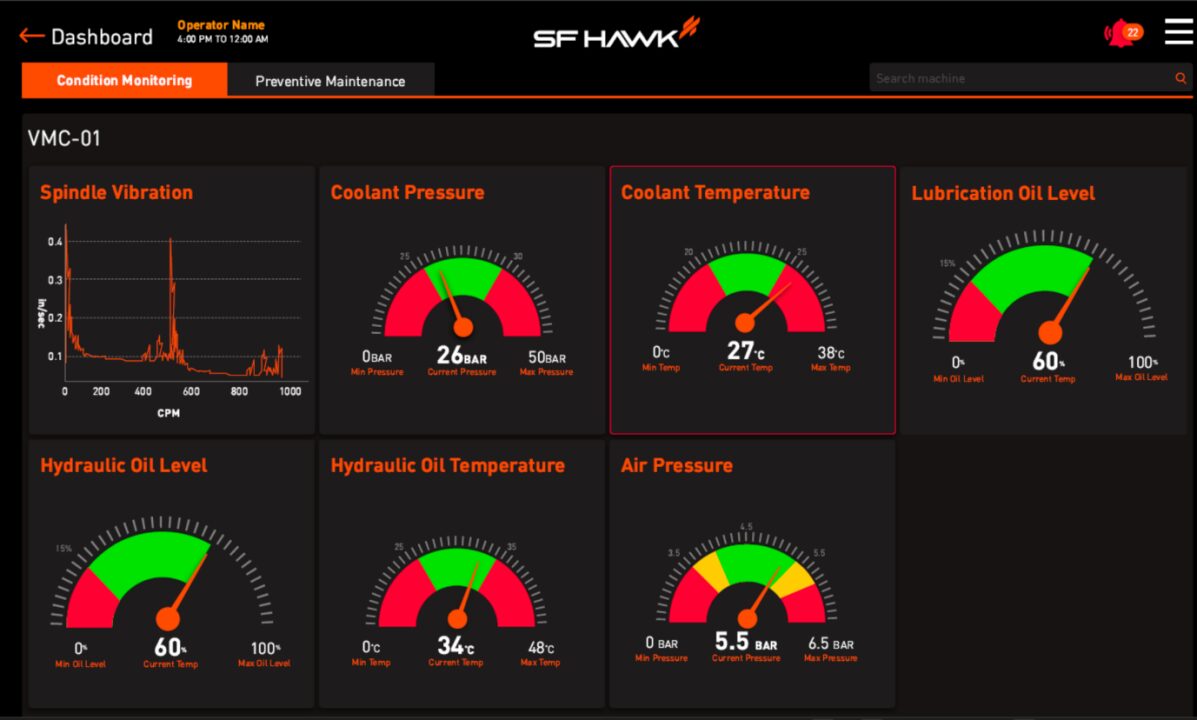
                      Machine Monitoring and CNC: Driving Smart Manufacturing’s Future

                      30 Sep, 2025

                        Every second of machine downtime has an effect on profitability and productivity in the world of modern manufacturing. Businesses require intelligence, connectivity, and control in addition to machines in order to stay ahead of the competition. sfHawk CNC Machine Monitoring Software provide precisely that.

                        sfHawk turns your shop floor into a smart factory solution that gives operators, managers, and decision-makers more power by fusing centralized CNC program management with real time production monitoring systems.


                        The Significance of Machine Monitoring in the Current Industry

                        Manufacturing is now more than just making parts; it’s about doing it more quickly, intelligently, and error-free. The CNC machine monitoring software from sfHawk functions as your shop floor machine management system, offering:


                        OEE monitoring system and real-time machine condition monitoring: Check the status of your CNC, VMC machine monitoring system, or HMC machine monitoring system in real time.

                        OEE tracking software: Precise assessment of performance, quality, and availability to increase productivity.

                        Tooling machine monitoring system: Monitor tool performance closely and use insights to prolong tool life with advanced CNC tool life monitoring software.

                        Production monitoring display system: Provide managers and operators with lucid, visual dashboards.

                        Remote machine monitoring: Machine health and production status can be accessed from anywhere, anytime.

                        Manufacturers can now make data-driven decisions that decrease downtime, boost throughput, and increase ROI by doing away with guesswork thanks to sfHawk.


                        CNC: More Intelligent CNC Program Administration

                        Production is frequently slowed down by outdated files and programming errors. Smooth communication between machines and operators is guaranteed by sfHawk’s shop floor machine management software with CNC functionality.

                        No more looking for the correct version of a program thanks to centralized CNC program storage.

                        Error-free transfers: Secure and automated transfers help minimize errors caused by manual loading.

                        Traceability solutions for CNC machine operator: Monitor program approvals, modifications, and usage.

                        Maintain total transparency for each production batch with a component traceability system.

                        This increases accuracy and consistency in each cycle by ensuring that your CNC automation companies’ equipment, VMC, and HMC machines always receive the right instructions.


                        Reliability through Predictive and Preventive Maintenance

                        Unexpected malfunctions are expensive. To maintain the health of your machines, sfHawk incorporates condition monitoring and predictive maintenance systems.

                        Equipment health monitoring system: Track temperature, vibrations, and spindle load analysis monitoring continuously.

                        Preventive maintenance monitoring system: Plan services in advance of malfunctions.

                        Optimize tool usage and avoid unplanned failures with CNC tool life monitoring software.

                        SPC charts for CNC machines: Monitor quality patterns to increase first-pass yield.

                        sfHawk guarantees the smooth and effective operation of your shop floor with industrial IoT for predictive maintenance and equipment condition monitoring systems.


                        Smart Manufacturing with sfHawk

                        sfHawk is more than just software, it’s a digital factory solution designed for the Industry 4.0 era.


                        Smart industrial automation – Connect machines, operators, and data seamlessly.

                        Intelligent manufacturing solutions – Use insights to optimize performance and reduce waste.

                        Industrial manufacturing solutions – Adaptable to CNC, VMC, HMC, and other industrial equipment monitoring systems.

                        Digital factory software – Real-time dashboards and analytics for total visibility.

                        Smart factory automation – Driving connected, data-led shop floors.

                        sfHawk is trusted by leading industrial automation companies and industrial automation and control systems companies to drive efficiency, quality, and innovation.


                        The Competitive Edge

                        sfHawk’s shop floor machine management software and OEE monitoring software benefit manufacturers in the following ways:


                        ✅ Increased efficiency with real-time data

                        ✅ Reduce downtime with the help of predictive maintenance and system.

                        ✅ Improved traceability systems for quality control

                        ✅ Better choices enabled by digital factory solutions and dashboards

                        ✅ Smooth interaction with current industrial automation and control systems


                        The Future is Smart, The Future is sfHawk

                        The markets of the future will be dominated by manufacturers who adopt smart manufacturing solutions and smart factory automation today. With sfHawk, you can monitor, predict, optimize, and control your production like never before.


                        Your machines have tales to tell. Are you prepared to hear sfHawk out?

                        Need a Custom Solution for Your Factory?

                        Reach out to:

                        👤 Nirav Lad Sr. General Manager – Sales

                        📱 +91 91120 98351

                        📧 nirav.lad@sfhawk.com

                        🌐 www.sfhawk.com 📍 sfHawk Solutions Pvt. Ltd. Unit 103, Supreme Headquarters, Above Tata Showroom, Baner, Pune, Maharashtra 411045

                        Industry 4.0: Opening the Door with the Integration of AI and Machine Learning in Manufacturing

                        12 Sep, 2025

                          AI and machine learning are quickly developing into the basis of smart manufacturing solutions in the new norm of Industry 4.0 technology. These capabilities are enhancing how manufacturers anticipate maintenance needs, improve efficiency, and optimize operations. Today, AI and ML are more than just trends; They are powerful instruments facilitating change on the production floor. This piece will explore how innovations such as real-time production monitoring systems, predictive maintenance, and OEE (Overall Equipment Efficiency) improvements are transforming the manufacturing industry. We will also examine how advancements such as industrial IoT solutions, tooling machine monitoring systems, and CNC machine monitoring software are paving the way for a smarter and more efficient future. AI and Machine Learning: The Heart of Smart Manufacturing  Machine learning and artificial intelligence are aiding the transition from traditional manufacturing settings to smart factories. These technologies enable the implementation of real-time and real data intelligent manufacturing solutions. Incorporating machine learning allows manufacturers to gain insights on machine behavior and operational efficiency.  At the core of this technology are real-time production monitoring systems. These systems interface and directly connect to CNC machines and various machines monitoring systems, supplying machine-level data on performance in real-time. This enables shop floor operators to remotely manage machines so they can recognize potential bottlenecks and optimize production in a timely manner.  Businesses can track and improve machine performance with OEE tracking and monitoring tools. These tools examine a machine’s availability, performance, and quality, enabling manufacturers to improve their OEE monitoring systems and throughput. These systems can then be integrated with intelligent tools so performance is predicted, and they can turn off machines to minimize system downtime. Predictive Maintenance: Staying Ahead of Machine Failures  Predictive maintenance stems from and utilizes the immense capabilities of AI and ML technologies. Predictive maintenance is an AI-based approach for calculating maintenance and breakdown downtime. Leveraging AI for maintenance requires the AI systems to have access to the machine condition monitoring system. AI systems have access to the observations derived from the CNC tool life monitoring software and the spindle load analysis monitoring tool.  Machine Condition Monitoring Systems improve on predictive maintenance by employing AI analysis on real-time conditions and dynamically adjusting the predictions aligned with the real-time variables of the system. IIoT predictive maintenance solutions are a necessity for any industry that relies on CNC automation.  An operator’s remote machine monitoring allows them to ascertain that the machine is operating as desired even when the operator is not physically on the shop floor. The real-time condition monitoring of the machine and the machine health monitoring systems provide the information needed to make timely and informed decisions on the maintenance schedules, which ultimately increases productivity and cost savings.  Real-Time Monitoring: Optimizing Efficiency Across the Shop Floor  Keeping track of real-time information in a manufacturing culture is a must. Real-time machine condition monitoring systems as well as real-time monitoring of production systems provide information to manufacturers concerning the performance of their machines. These systems monitor the functioning of all the machines in the production line and all the processes associated with the machines to ensure that all machines are optimally functioning.  CNC machine monitoring software is just one example of systems designed to track a machine’s performance. AI systems evaluate performance and provide information to operators to enable corrective action to be taken on performance or efficiency blockages. With the integration of production monitoring systems to OEE monitoring systems, improved decision-making, reduced downtime, and increased productivity are captured.   Manufacturing of other shop floor machines, such as VMC and HMC machines, also falls under and is not omitted in this type of monitoring. The overall comprehensive performance of the factory is increased by AI and ML systems, which provide predictive maintenance and ensure machines are always operating at peak. IIoT solutions set manufacturers ahead of schedule by avoiding expensive unscheduled downtimes. The Future of Manufacturing: A Unified, Data-Driven Approach  The integration of advanced technologies, such as AI, ML, and IIoT in smart factories, transcends automation, integrating intelligent manufacturing techniques and automation of broader industrial control systems, enabling manufacturers to create more flexible and efficient production lines.  As smart factories become more prevalent, systems like AI, ML, and machine control centers (MCC) will help integrate real-time data to process and augment advanced algorithms, perform predictive maintenance, and create an intelligent structure to scale parameters of the entire production line to ensure optimal conditions.  Focusing on the construction of cohesive digital control systems, the emergence of digital factory software and solutions consolidates the control of factory dynamics, allowing businesses to oversee the entire process from one place to enhance efficiency. Metrics from individual systems, such as milling tools, predictive maintenance, and spindle load monitors, are combined to ensure the factory dynamics function as a cohesive system.  Also, Industrial IoT predictive maintenance systems will enable manufacturers to monitor equipment and production lines in real time. Conclusion:   AI and ML in Manufacturing – The Future is Here AI and machine learning are today being implemented in manufacturing procedures; they’re not just a future proposition. As the Fourth Industrial Revolution unfolds, AI and ML are quickly becoming the legacy and foundational building blocks for intelligent manufacturing solutions. These advancements in technology will alter the way manufacturers view maintenance requirements, optimize productivity, and ensure operational efficiency. Today, AI and ML will be reconfiguring tools for change at the production level. 

                          Connect with us @inquiry@sfhawk.com www.sfhawk.com +91 9112098351

                          OEE Software & CNC Machine Monitoring: Powering Data-Driven Manufacturing

                          2 Sep, 2025


                            What Is Machine Monitoring Software and Why Does It Matter?

                            Machine monitoring software is a powerful digital tool that connects directly to industrial machines such as CNC, VMC, HMC, and other production equipment. It tracks essential metrics such as machine status, cycle time, downtime reasons, production counts, and utilization rates. This software allows operators, managers, and other stakeholders to monitor performance in real-time, providing transparency and facilitating data-driven decisions. Instead of relying on manual inputs or delayed reports, manufacturers now have continuous, accurate data at their fingertips. The software helps manufacturers keep track of machine availability, performance, and quality — the three key components of Overall Equipment Effectiveness (OEE). OEE is a metric used to measure how efficiently equipment is performing compared to its full potential. Monitoring OEE using CNC machine monitoring software provides manufacturers with a clear view of where improvements are needed to boost efficiency and drive higher-quality production.

                            CNC Machine Monitoring Software: Optimizing Precision Manufacturing

                            CNC machines are vital in industries requiring high precision, such as metalworking, automotive, and aerospace manufacturing. CNC machine monitoring software connects directly with CNC, VMC, and HMC machines to collect real-time performance data. This enables manufacturers to monitor machine utilization, identify potential issues before they cause significant downtime, and ensure that machines are running at their optimal capacity. With CNC machine monitoring software, manufacturers can track machine health, identify wear and tear early on, and perform predictive maintenance to avoid costly breakdowns. This proactive approach minimizes unscheduled downtime and ensures that machines are always ready for production.

                            What Is a Machine Monitoring System?

                            A machine monitoring system is a comprehensive setup that combines hardware and software to track, analyze, and improve machine performance in real-time. The system typically includes IoT devices, sensors, and a centralized platform that collects and displays data in an easily understandable format. This interconnected system ensures that all machines on the shop floor are monitored continuously and provides a detailed overview of the entire production process. The machine monitoring system is instrumental in creating a data-driven, efficient manufacturing environment. By integrating various sensors and IoT devices, it delivers continuous, real-time updates on machine status, downtime, performance, and other key metrics. This allows manufacturers to optimize operations and make informed decisions based on accurate, real-time data.

                            Key Advantages of Machine Monitoring Software & CNC Machine Monitoring Software

                            1. Quick Decision Making Based on Real-Time Data

                            One of the greatest advantages of machine monitoring software is its ability to provide real-time insights into machine performance. Operators and managers can immediately detect whether a machine is operating at full capacity or experiencing issues that lead to delays. This capability reduces idle time, helps keep production on schedule, and maximizes machine output.

                            2. Preventive Maintenance to Minimize Downtime

                            Machine monitoring software equipped with Industrial IoT (IIoT) sensors can provide predictive maintenance capabilities. By analyzing real-time data, manufacturers can predict when a machine is likely to fail or require maintenance. This enables businesses to schedule maintenance during non-production hours, preventing unexpected downtime and increasing OEE.

                            3. Improved Production Efficiency

                            By tracking and analyzing key performance metrics, OEE machine monitoring software allows manufacturers to pinpoint inefficiencies in their production process. Whether it’s slow machine startups, underperformance, or quality control issues, this data enables managers to streamline processes, reduce waste, and maximize production efficiency.

                            4. Enhanced Machine Uptime

                            CNC machine monitoring software ensures continuous monitoring of machine performance. By identifying potential issues before they escalate, the software helps prevent unplanned breakdowns, keeping machines running smoothly. As a result, manufacturers can achieve higher machine uptime, improving overall production capacity and efficiency.

                            5. Real-Time Analytics for Shop Floor Visibility

                            The shop floor is the heartbeat of any manufacturing operation. Machine monitoring software provides valuable analytics that offer insights into machine performance across the shop floor. Managers can view trends, identify bottlenecks, and pinpoint areas for improvement. This empowers them to make informed decisions that maximize efficiency and eliminate production delays.

                            6. Optimized Resource Allocation

                            With the data provided by machine monitoring systems, manufacturers can better allocate resources. Whether adjusting workloads, realigning production schedules, or rebalancing tasks, the insights offered by the software help optimize production planning, ensuring that resources are used efficiently and effectively.

                            7. Seamless Integration with Automation

                            As part of Industry 4.0, CNC machine monitoring software integrates seamlessly with automation systems. This connectivity enables machines, robots, and operators to collaborate more efficiently, reducing the likelihood of human errors and improving the overall production process. The interconnected system ensures that everything from machine operation to quality control is automated, leading to higher productivity and fewer mistakes.

                            Machine Monitoring Software and OEE in Industry 4.0

                            In the era of Industry 4.0, digital transformation is central to the success of manufacturing operations. Machine monitoring software and OEE machine monitoring software are pivotal in this transformation, as they enable the connected, data-driven environments that define smart factories. With IoT-enabled machines and real-time data analytics, manufacturers can optimize every aspect of their operations. AI and machine learning are playing an increasing role in predictive diagnostics, allowing companies to monitor machine health and optimize uptime. Cloud-based solutions enable managers to access machine performance data from anywhere, fostering better decision-making and greater flexibility. By adopting CNC machine monitoring software as part of their Industry 4.0 strategy, manufacturers can gain unparalleled insight into their operations, driving smarter production processes and maintaining a competitive edge.

                            Why Adopt Machine Monitoring Software and CNC Machine Monitoring Now?

                            The future of manufacturing is undeniably data-driven, and machine monitoring software offers manufacturers a direct path to increased efficiency, reduced downtime, and higher-quality products. Delaying the adoption of this technology means missing out on valuable opportunities to:
                            • Reduce operational costs by improving machine efficiency and minimizing downtime.
                            • Enhance throughput by eliminating bottlenecks and speeding up production.
                            • Make informed, data-driven decisions that lead to better outcomes for the business.
                            • Stay competitive in an increasingly digital, automated manufacturing landscape.
                            Adopting OEE machine monitoring software and CNC machine monitoring software ensures that manufacturers can optimize their production lines, improve machine health, and achieve their operational goals.

                            How sfHawk Enhances Machine Monitoring

                            Solutions like sfHawk are designed specifically for manufacturing environments to make machine monitoring systems even more effective. sfHawk connects seamlessly with machines like CNC and VMC to capture real-time data and deliver actionable insights through its advanced analytics platform. Features like downtime analysis, machine utilization tracking, and OEE monitoring help manufacturers identify inefficiencies, reduce waste, and improve productivity. sfHawk offers manufacturers a simple and practical solution to monitor machine performance, increase uptime, and ensure high-quality production. Its user-friendly interface and powerful backend make it an ideal choice for companies looking to integrate machine monitoring software into their operations and embrace the benefits of Industry 4.0.

                            Final Thoughts

                            In today’s fast-paced manufacturing world, machine monitoring software and CNC machine monitoring software are crucial for achieving operational excellence. These tools empower manufacturers with real-time data, predictive maintenance capabilities, and enhanced production planning, all of which contribute to increased OEE and reduced downtime. By integrating machine monitoring systems into your production environment, you position your business to thrive in the age of Industry 4.0 and stay competitive in the digital era. If you are looking to improve machine efficiency, reduce downtime, and maximize production output, it’s time to invest in machine monitoring software and CNC machine monitoring solutions. Adopting these technologies will set your business on the path to smarter, more efficient manufacturing operations.

                            Connect Us

                            🌐 www.sfhawk.com 📧inquiry@sfhawk.com 📞91120 98351  

                            Successfully embracing Industry 4.0: don’t forget the people aspects!

                            18 Jan, 2025

                              Introducing Industry 4.0

                              The term “Industry 4.0” refers to the many ways in which manufacturing companies (both OEM players and their suppliers) can improve productivity, quality, cost-efficiency and flexibility of their production facilities on the basis of actionable insights harvested from analysis of real-time data. “Smart factories” with cyber-physical systems and high levels of “intelligent automation” are a key element of Industry 4.0; adoption is expected to transform industrial value chains worldwide.

                              Another key premise of Industry 4.0 is that actions must be triggered by real-time data, relying less on predictive models or human judgment. Put differently, supervisors and factory managers will need to rely more on data points gathered from machines instead of relying on an experienced shop floor worker saying “It’s time to replace this tool because it looks worn out” or “The toolhead has run for X hours, which is when the manufacturer recommends replacement”.

                              Addressing people aspects is crucial to realizing the benefits of Industry 4.0

                              A manufacturing enterprise adopting Industry 4.0 well will derive substantial benefits. But as in the case of most transformation programs, a lot of attention is paid to the “hard” aspects- investments in shop floor automation, process redesign, information technology etc. But what will be crucial is how well companies handle the “soft aspects”. Technology can give your business data and insights. But what you do with those insights is what will make a real difference- and that ultimately depends on your people. This is an important point to keep in mind for companies in the manufacturing sector on journeys to adopt “Industry 4.0” ways of thinking and doing.

                              If the mindset of workers, supervisors and factory managers is not changed, they will continue to work in old ways- and that will lead to sub-optimal results. Imagine printing out e-mails, dictating responses and having a secretary type it back as an e-mail! (Yes, we all know people who actually did this 25 years ago, but it is unthinkable in today’s context).

                              How successful your enterprise will be in harnessing achieving the transformative potential of Industry 4.0 will depend significantly on how well you implement these “people actions” in your shop floor or factory:

                              • Starting the process of mindset change before implementation begins; explaining why and how this is a better way of working and is not meant to cut down staff.
                              • Train operators on the new ways of working; explain that the way they operate the tool or machine will not change, but that they will need to pay attention to alerts triggered by the solution.
                              • Explain that the data will supplement their own judgment- rather than mistrust hard data, encourage them to “compete” and see if their judgment and experience are supported by the data. Get them to act on the basis of data-driven alerts and not assume false positives because they don’t “feel” that the alert is reliable.
                              • Manage fears of job losses due to higher levels of automation by highlighting how superior quality and productivity has the potential to open up revenue opportunities, in turn creating demand for more workers.
                              • Build trust not just with operators but also with others in the ecosystem (e.g., suppliers), so they too understand how much more important it is for them to supply quality materials or components on time.
                              • In the new landscape where a lot more data is generated, captured and stored by cyber-physical systems, employees must be trained to be extra vigilant about use of unauthorized pen drives etc.
                              • This kind of transformation is not just about shop floor staff; HR must sensitize managers and leaders on how governance, goals and even their roles will change in the new environment. They may need to be trained on emotional intelligence, communication, goal-setting, giving feedback etc.
                              • Policies relating to performance management, rewards etc. will need to be redefined.

                              Here are three specific tips to help your organization reap the benefits of embracing Industry 4.0:

                              • Implement a process to gather stakeholder concerns even after the initial training. Use this feedback to tweak the relevant dimensions of the solution.
                              • In every team, designate change agents who address questions/concerns, encourage mindset change and come up with new use cases.
                              • Institute a system to reward fast learners as well as employees who suggest new use cases, so that incremental gains can be made.

                              Not managing people aspects proactively can derail realization of your ROI targets

                              As part of the shift to Industry 4.0, the entire culture of the organization will undergo a change. Employee resistance to the new ways of working can delay the time it takes to realize productivity gains and/or cost reductions. Opportunities for higher revenue may be lost due to production delays caused by longer setup times, higher defect rates, or inefficient inventory management. To minimize the risk of the expected ROI not being realized, leaders must consciously pay attention to the people and culture aspects of the transformation.

                              Choosing the right IoT solution for your factory need not be a struggle

                              18 Jan, 2025

                                Selecting software solutions for a business enterprise has always been a difficult decision for many reasons, including the following:

                                • Stakeholders may not understand the technology aspects, or appreciate how the solution will tangibly improve competitive advantage (i.e., reduce costs or time to market, improve collaboration, decision-making or operational excellence, get closer to customers etc.).
                                • The existing technology landscape may impose certain constraints, which, if not considered before the decision is made, may lead to additional costs and/or delays in implementation.
                                • In-house teams may be unfamiliar with newer technologies, and hence end up relying on the vendor’s assertions and assurances to a much higher degree than desirable.
                                • The solution may not possess all the functionalities the enterprise needs.
                                • Users may resist using the software because it represents a major shift from their zones of comfort. Inadequate training of users before roll-out may increase resistance.
                                • In the absence of clear business goals that the software is expected to deliver, assessing ROI and project success becomes much harder and more subjective.

                                The above apply just as much to large companies as to MSMEs. And they are as relevant for selecting factory-level IoT solutions to drive your company’s Industry 4.0 strategy as they are to selecting other functional solutions.

                                Based on our experience of working with manufacturing companies, here are some tips for you, as a decision-maker or influencer in selecting IoT solutions for your factory, to ensure that you do, in fact, select the best available solution.

                                • Do not fear IoT because it is a new concept or captures data from non-computers. Remember that CNC machines today probably have as much processing power inside them as computers did at the turn of the century.
                                • Start with a clear overall vision of where you want your business to be in say, 5 years, including what role your manufacturing facilities and “Industry 4.0” will play in getting there. Articulate how far you want to go on the “Industry 4.0” journey in the next 3 years or so. This vision must be clearly-articulated and must be signed-off by the C-suite.
                                • Identify specific outcomes you seek and map them to available solutions before selecting one. Working with use cases can give you a more realistic basis to assess “fit” of a solution with your objectives and vision.
                                • IoT adoption need not be long-drawn, expensive projects. Start small, and scale up gradually.
                                • All else being equal, select solutions that are more intuitive to understand and easier to use; this will enhance adoption by various stakeholders. But make sure that the architecture is flexible and the solution is built using modern technology.
                                • Right from the start, assess the solution for scalability, ease of implementation (including likely disruption to operations)and data security (including where data will be stored).
                                • Based on agreed priorities within the company and factory, implement solution pilots for one or two specific use cases. Use these pilots to iron out wrinkles such as enhancing buy-in (especially amongst supervisors and workers), refining performance metrics and what data points will objectively help in measurement, and setting up protocols to use the alerts that the pilot solution will throw up.
                                • Based on how well the solution is able to deliver on the promised outcomes, assess its scalability across your other assembly lines and factories. Implementing multiple IoT solutions will only complicate matters.
                                • Share the results with all the stakeholders, including workers. If the outcomes are not as expected, work with the solution provider to analyse root causes and work with the relevant stakeholders to ensure that they are fixed. Identify “champions of change” in every line and shift, who are jointly accountable for improving outcomes.
                                • The pricing aspect of solutions is important too. Be willing to try innovative pricing models such as pay per piece or outcome based- e.g., a lower fixed price combined with a % of the money saved.
                                • Plan for user training in collaboration with the vendor. Involve experts from the vendor organization for the actual training so that changes to the implementation can be made if necessary to simplify things for users.

                                Successfully implementing IoT solutions depends on more than just the right technology investments. Realizing the targeted benefits depends on the human element- creating a conducive workplace culture, promoting buy-in amongst all stakeholders and frequent, open communication.

                                We’d love to hear about your IoT adoption journeys, so do share them via comments or write to us.

                                Improving your Machine Uptime with sfHawk

                                17 Jan, 2025

                                  Enhancing Machine Uptime with sfHawk: A Smart Factory Solution.

                                  In the fast-paced world of manufacturing, machine uptime is a critical factor that directly impacts productivity and profitability. Every minute a machine is down, your production schedule, efficiency, where sfHawk comes in—a smart factory solution that not only enhances machine uptime but also optimizes overall equipment effectiveness (OEE), production quality control, and machine productivity.

                                  The Importance of Machine Uptime

                                  Machine uptime refers to the amount of time that a machine is operational and capable of performing its tasks without interruptions. High uptime is synonymous with high productivity, as machines are kept running smoothly and efficiently, reducing the need for costly repairs and minimizing delays in production. However, achieving consistent machine uptime requires a sophisticated approach to machine monitoring and maintenance.

                                  How have Smart Factories helped in the US?

                                  Over the past decade, the manufacturing landscape in the United States has undergone a significant transformation, largely due to the adoption of smart factory solutions. These technological advancements have led to remarkable improvements in machine uptime across various industries.

                                  A notable 2021 report by Deloitte shed light on this trend, revealing that manufacturers who implemented Industrial Internet of Things (IIoT) solutions experienced substantial benefits. These solutions, which include real-time monitoring and predictive maintenance capabilities, resulted in an impressive reduction in downtime – up to 25% in some cases.

                                  The impact has been particularly pronounced in sectors where machine uptime is crucial, such as automotive and aerospace. In these industries, companies leveraging smart factory technologies observed a 15% increase in overall equipment effectiveness (OEE). This metric is a key indicator of production efficiency and reliability.

                                  What’s driving these improvements? The answer lies in the integration of cutting-edge technologies. Advanced sensors, artificial intelligence-powered analytics, and cloud platforms work in tandem to provide real-time insights into machine performance. This allows for proactive interventions, effectively minimizing unplanned failures and optimizing production processes.

                                  In essence, these smart factory solutions are revolutionizing the way manufacturers approach machine maintenance and productivity. By enabling data-driven decision-making and predictive capabilities, they’re helping industries stay ahead of potential issues and maintain peak operational efficiency.

                                  How sfHawk Boosts Machine Uptime

                                  sfHawk’s cutting-edge machine monitoring system offers real-time insights into your machines’ performance. By continuously tracking and analyzing critical parameters such as machine health, operator efficiency, and tool conditions, sfHawk helps prevent unexpected downtimes and enhances productivity.

                                    1. Predictive Maintenance: With sfHawk’s smart sensors and data analytics, you can implement predictive maintenance strategies that forecast potential machine failures before they occur. This proactive approach significantly reduces unplanned downtime, ensuring that your machines stay operational longer.
                                    1. Real-Time Monitoring: sfHawk provides live updates on machine status, allowing you to address issues as they arise. This real-time visibility into your shop-floor operations means you can take immediate action to resolve any potential problems, ensuring maximum uptime.
                                    1. OEE Optimization: Our platform is designed to optimize OEE by balancing machine availability, performance, and quality. By improving uptime and reducing cycle times, sfHawk enables your factory to achieve higher OEE, translating into more efficient production and better quality control.
                                    1. Improved Production Quality Control: Uptime isn’t just about keeping machines running—it’s also about maintaining consistent production quality. sfHawk’s intelligent monitoring ensures that machines are operating within optimal parameters, minimizing the risk of defects and ensuring that your products meet the highest standards.

                                  Predictive maintenance with sfHawk

                                  sfHawk offers a comprehensive preventive maintenance solution designed to optimize machine performance and reduce downtime in manufacturing environments. This system integrates several key features to provide a holistic approach to equipment maintenance and monitoring.

                                  At the heart of sfHawk’s solution is a central dashboard that offers both overview and detailed insights into maintenance tasks across all machines. This dashboard provides real-time visibility into completed and pending maintenance activities, allowing managers to quickly assess the maintenance status of their entire fleet. Users can easily track how many maintenance tasks have been performed on each machine and identify any overdue or upcoming tasks, ensuring that no critical maintenance is overlooked.

                                  The system also incorporates advanced sensor and temperature monitoring capabilities. By continuously tracking various parameters, sfHawk can detect anomalies or trends that might indicate potential issues before they escalate into major problems. This proactive approach helps prevent unexpected breakdowns and extends the lifespan of equipment.

                                  Another crucial feature is spindle load monitoring. This functionality is particularly valuable for CNC machines and other equipment where spindle performance is critical. By monitoring spindle load in real-time, sfHawk can alert operators to potential overloading or underperformance, helping to maintain optimal cutting conditions and prevent premature wear or damage.

                                  Key pointers:

                                    1. Central Dashboard:
                                      1. Provides overview and detailed views of maintenance tasks
                                      2. Shows completed and pending tasks for each machine
                                      3. Enables quick assessment of fleet-wide maintenance status
                                    2. Sensor and Temperature Monitoring:
                                      1. Continuous tracking of various machine parameters
                                      2. Early detection of anomalies and concerning trends
                                      3. Helps prevent unexpected breakdowns
                                    3. Spindle Load Monitoring:
                                      1. Real-time monitoring of spindle performance
                                      2. Alerts for potential overloading or underperformance
                                      3. Maintains optimal cutting conditions and prevents premature wear

                                  These features work together to create a robust preventive maintenance system, helping manufacturers minimize downtime, optimize machine performance, and extend equipment lifespan.

                                  Why Choose sfHawk?

                                  sfHawk isn’t just a machine monitoring system—it’s a comprehensive smart factory solution that empowers you to take full control of your production floor. By enhancing machine uptime, optimizing OEE, and improving production quality control, sfHawk helps you unlock new levels of efficiency and productivity.

                                  In a competitive manufacturing environment, every second counts. With sfHawk, you can ensure that your machines are performing at their best, your production processes are streamlined, and your business is always ahead of the curve.

                                  Conclusion

                                  In today’s fast-paced manufacturing environment, every second of machine uptime counts. With sfHawk’s advanced smart factory solutions, you can minimize downtime, improve productivity, and stay ahead of the competition. Whether you’re aiming to boost your Overall Equipment Effectiveness (OEE) or enhance production quality, sfHawk gives you the tools to take full control of your operations.

                                  Don’t wait until the next unexpected breakdown costs you time and money. Get in touch with our team today to schedule a demo and see how sfHawk can revolutionize your factory’s performance. Let’s work together to ensure your machines are always operating at their peak.

                                  References:

                                  https://www2.deloitte.com/content/dam/Deloitte/de/Documents/deloitte-analytics/Deloitte_Predictive-Maintenance_PositionPaper.pdf https://www.mckinsey.com/capabilities/mckinsey-digital/our-insights/a-manufacturers-guide-to-generating-value-at-scale-with-industrial-iot

                                  State of adoption of Industry 4.0 in India

                                  17 Jan, 2025

                                    Time flies! It’s ten years since the term “Industry 4.0” was first used by the German government to articulate its strategy to enhance the competitiveness of the country’s manufacturing industry. The concept gathered momentum after it became a key theme at the World Economic Forum in 2016. Adoption in India has been slow thus far, but that will change soon.

                                    The rise of Industry 4.0

                                    The last decade also witnessed the emergence and maturing of a wide range of digital technologies, computing capabilities and application areas. These include AI and Machine Learning, Robotics, 3D Printing, Data Sciences and Analytics, Cloud, IOT, Augmented Reality etc. While data processing and computing capabilities have grown exponentially, unit costs have decreased just as rapidly.

                                    It is the confluence of the above-mentioned trends that has led to the thinking behind Industry 4.0 and its cousins, “digitalization” and “4th Industrial Revolution”, make its way into the C-suite and documented strategies of many companies worldwide. In India too, I4.0 has started gathering momentum in the last couple of years, although the rate of adoption is still relatively slow.

                                    Indian companies too will increase the pace of I4.0 adoption in the next year or two as a result of both internal and external imperatives. For instance, in the automotive industry, as global players embrace I4.0, India-based suppliers will need to ensure that they keep pace with rising expectations around traceability requirements and quality norms. In addition to improving asset utilization, IoT solutions can also help companies address the challenge of shrinking supplies of skilled human resources for shop floors and assembly lines.

                                    As companies face a squeeze on margins (something that the ongoing pandemic has further compounded), the competitive pressure to reduce costs sustainably will only increase. In industries such as manufacturing, logistics and construction, adopting Industry 4.0 paradigms will help cut down waste, improve productivity and reduce carbon footprint.

                                    Adoption in India remains limited

                                    There is reasonable awareness amongst Indian manufacturing companies around how Industry 4.0 will be a game-changer for early adopters as well as adoption intent.

                                    The government of India too has taken steps to encourage adoption of I4.0. In addition to an enabling framework, the Department of Heavy Industries has set up Samarth Udyog Bharat 4.0 (Smart Advanced Manufacturing and Rapid Transformation Hubs) to create awareness and propagate an ecosystem of technology solutions. The rollout of 5G communication protocols in the next year or two is further expected to accelerate the shift, as it will make the use of IIOT more viable and more efficient. However, actual activity towards adoption remains constrained by many factors such as these:

                                    • Limited understanding of Industry 4.0 and its value as an important step towards long-term transformation of the entire business (and not just from an operations angle);
                                    •  Inadequate clarity around the expected business value and prioritization (based on what problems need to be solved);
                                    • Appreciation of dependencies caused by existing systems, architectures, and availability of good quality data of the desired granularity;
                                    •  Concerns around data security;
                                    •  Lack of a detailed plan and a well thought out long-term roadmap; and perhaps above all,
                                    • The perception that adoption of Industry 4.0 solutions is necessarily a large and complex program that requires massive investments (with unclear RoI). This reinforces the belief that I4.0 is only for the larger companies or those that have deep pockets- something that is erroneous.

                                    In recent days, we at sfHawk are seeing a perceptible shift in gears. Large players as well as SMEs are engaging more willingly and with higher levels of seriousness than before, to understand how Industry 4.0 solutions can help them. The scope of our conversations with automotive OEMs and auto component suppliers has expanded from production monitoring or OEE improvement to enabling traceability, tool cost optimization and predictive maintenance.

                                    Manufacturing companies may not always possess the required levels of technical expertise to efficiently integrate Industry 4.0 solutions. That is why we at sfHawk encourage companies to articulate their problem statements in the form of easily-understood use cases. We then work with them to provide solutions for those use cases. The value is demonstrated using pilots that can then be scaled up. We believe that companies must look for solutions that, in addition to addressing their immediate needs, are scalable to address future needs as well.

                                    We know that large-scale shifts such as adoption of Industry 4.0 paradigms are disruptive to the culture of the organization. This is especially true for manufacturing businesses in India, where there has been long-standing distrust between owner-managers and workers. Adopting the right Industry 4.0 solutions will lead to a reduced dependence on human judgement. This reduces the risk of human errors of omission or commission that, in turn, increase setup time or material wastage. However, if the buy-in of workers is not gained by explaining the rationale for embracing I4.0 and benefits to all stakeholders, adoption will only become more difficult. This is an important aspect that business leaders must factor into their plans to embrace I4.0.

                                    If you have additional insights to share based on your I4.0 experience, we’d love to know: please post a comment or write to us.