Machine downtime tracking software records the exact duration, cause, and cost of every stoppage on the shop floor. Paired with OEE software and machine monitoring software, it turns downtime from an accepted cost of doing business into a measurable problem you can systematically eliminate, protecting revenue and delivery commitments in the process.
Unplanned downtime is not just an operational inconvenience. It is capital that has stopped working, revenue that has quietly disappeared, and customer confidence eroding one missed delivery at a time. Most manufacturing operations still treat downtime as inevitable rather than preventable, largely because they lack the data to prove otherwise.
Machine downtime tracking software changes that. Instead of accepting stoppages as “part of the job,” manufacturers using this technology can identify exactly where time is lost and act on it before it repeats.
What Is Machine Downtime Tracking Software?
Machine downtime tracking software is a category of
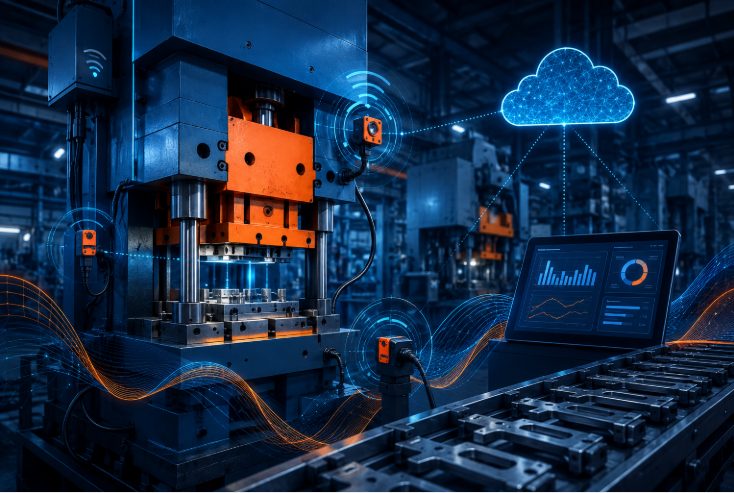
factory production monitoring software that automatically records when a machine stops, why it stopped, and how long it stayed down. It differs from manual downtime logs in one critical way: the data is captured in real time, directly from the machine or a connected sensor, rather than reconstructed later from an operator’s memory.
Why Understanding Your Downtime Profile Matters
Most operations do not actually understand their downtime in detail. They have a general sense that machines are not running, but without machine downtime tracking software, that picture stays fragmentary and unreliable.
A properly configured system reveals:
- Exact downtime duration for each incident, not an estimate
- Root cause categorization, so recurring patterns become visible
- Frequency analysis showing which machines fail most often
- Impact calculation revealing which stoppages cost the most
- Trend identification that feeds prevention strategy
This is where CNC machine monitoring software and broader factory monitoring software earn their keep: they convert downtime from an anecdotal complaint into a measurable, addressable operational problem, as shown in this
spindle load monitoring case study.
The Economics of Downtime: Why Tracking Matters
Downtime economics vary significantly by shop, machine type, and part complexity, so the figures below are illustrative benchmarks drawn from typical precision-machining operations rather than a fixed industry standard; use your own cost-per-hour figures to model your specific case.
A single CNC machine in a precision component shop can represent a meaningful daily revenue opportunity depending on the part and market it serves. Two hours of unplanned downtime, which can look minor in isolation, translates directly into lost output for that machine alone.
The effect compounds quickly across a shop floor:
| Scenario |
Machines |
Avg. Weekly Unplanned Downtime per Machine |
Approx. Monthly Revenue at Risk* |
| Small shop |
5 |
3 hours |
Moderate |
| Mid-size shop |
10 |
3 hours |
Significant |
| Large shop |
25 |
3 hours |
Substantial |
This is why machine downtime tracking software is a strategic investment rather than an operational nicety. It is not about chasing perfection; it is about protecting revenue that is already being lost.
What Should Machine Downtime Tracking Software Actually Track?
Many implementations capture that downtime occurred but miss the context needed to prevent it from happening again. A well-built system should track four categories of data.
Downtime Incidents
- Start time and end time
- Total duration
- Machine affected
- Operator assigned
- Supervisor notified
Root Causes
- Mechanical issues
- Tool breakage
- Electrical problems
- Operator error
- Material issues
- Setup and changeover delays
- Maintenance activities
Impact Metrics
- Production lost (units or time)
- Revenue impact
- Customer orders affected
- Quality implications
- Downstream delays
Context Factors
- Time since last maintenance
- Recent changeovers
- Tool age and life status
- Environmental conditions
- Operator experience level
This is what separates basic logging tools from enterprise-grade factory monitoring software: comprehensiveness and the ability to turn raw events into insight.
Using Downtime Data for Preventive Maintenance
Leading manufacturers use machine downtime tracking software for more than historical reporting. They feed it into
preventive maintenance planning so machines are serviced based on actual usage patterns and documented behavior, not a fixed calendar interval.
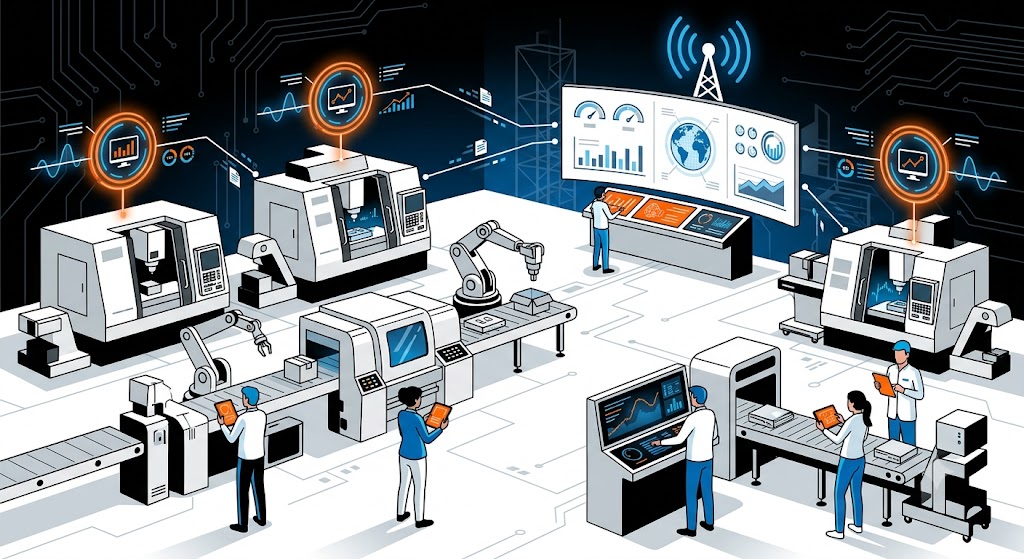
In practice, this looks like: machine monitoring software flags a tool wearing down based on cycle-to-cycle variance, factory monitoring software recognizes a pattern that typically precedes a mechanical fault, and the downtime tracking layer becomes the foundation of a maintenance strategy that prevents failures instead of reacting to them.
How Downtime Tracking Connects to OEE
OEE (Overall Equipment Effectiveness) is a standard manufacturing metric that measures how much of a machine’s planned production time is truly productive, combining availability, performance, and quality into a single score.
OEE monitoring software integrated with downtime tracking creates a closed-loop improvement cycle. In one documented rollout, a machine shop raised its OEE by 14 percentage points within six months of digitizing downtime and production data — see the
full case study for the details:
- Machine monitoring software captures production and downtime data in real time
- Downtime tracking software categorizes each interruption by type and cause
- OEE software calculates the impact on overall equipment effectiveness
- Analysis identifies which downtime categories carry the highest cost
- Improvement initiatives target the highest-impact categories first
- Machine monitoring software confirms whether the fix actually reduced downtime
This is continuous improvement driven by data, not by anecdote or assumption.
CNC Machine Monitoring Software and Early Warning Signals
CNC machines generate unusually rich data, which makes them a strong fit for downtime tracking. Advanced CNC machine monitoring software commonly tracks:
- Spindle load and temperature
- Cycle time variance
- Tool change frequency
- Program execution interruptions
- Coordinate system anomalies
When this data feeds into downtime tracking software, it creates an early warning system: the machine signals distress before it stops entirely, giving maintenance teams a window to intervene.
Rolling It Out: Who Uses This Data, and How
Technology alone does not fix downtime. Adoption across four organizational levels determines whether the system delivers results.
| Level |
Role in the System |
| Operator |
Primary data source; adoption improves when tracking is framed as a problem-solving tool, not surveillance |
| Supervisor |
Uses the data to spot patterns and coordinate real-time responses |
| Management |
Uses aggregated data for resource allocation and prioritizing fixes |
| Executive |
Reviews summarized impact on revenue protection, on-time delivery, and capacity utilization |
Measuring Success: Baseline Metrics to Track
Operational: total downtime hours per week, average downtime duration per incident, downtime per machine, downtime by root cause, repeat issues on the same machine.
Financial: revenue protected through prevented downtime, maintenance cost per incident, cost of extended lead times, and quality or warranty costs tied to rushed production.
Strategic: on-time delivery performance, capacity utilization improvement, maintenance efficiency gains, and overtime reduction.
Your dashboard should make these numbers visible and actionable, not buried in a monthly report no one reads.
Choosing Machine Downtime Tracking Software: What to Evaluate
- Integration: Does it connect to your existing ERP, scheduling, and maintenance management systems?
- Scalability: Will it grow with additional machines and locations?
- User adoption: Can operators and supervisors easily log and access data?
- Root cause taxonomy: Is the categorization flexible enough for your operation?
- Reporting: Does it generate the reports your management team actually needs?
Still have questions before you shortlist a vendor? Our
FAQ page covers the most common ones we hear from machine shops.
Downtime Elimination as Competitive Strategy
Machine downtime tracking software represents a shift from reactive maintenance to proactive optimization: it turns downtime from an accepted cost of doing business into a measurable, addressable problem.
Manufacturers who treat this as a revenue-protection investment, not an added expense, see the return compound over time. Every percentage point of downtime reduction flows directly to the bottom line, and the visibility it provides supports the kind of delivery reliability that competitors without this data cannot match.
Get Started Today! Book a call with sfHawk | Email: inquiry@sfhawk.com | Phone: +91 91120 98351 | Website: www.sfhawk.com