Press Shop Machine Monitoring: Real-Time OEE for Stamping and Press Operations
Press shops run on speed and repetition, which is exactly why small losses are hard to catch manually. A press that should run at 40 strokes a minute but is quietly running at 32 loses more output over a shift than one dramatic two hour breakdown, but nobody writes that down on a paper log. A press shop machine monitoring system connects directly to press controllers and PLCs to capture stroke rate, cycle time, and stop reasons automatically, closing that visibility gap. sfHawk’s production monitoring solution is built for exactly this kind of high-speed, high-repetition environment.
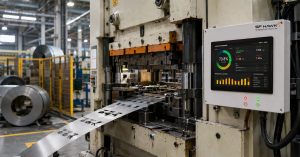
What a Press Shop Machine Monitoring System Actually Tracks
OEE (Overall Equipment Effectiveness) is the standard metric for measuring how well equipment is utilized, calculated as Availability multiplied by Performance multiplied by Quality. In a press shop, each of these three factors has its own set of common culprits:
- Availability losses: die changeovers, tonnage or overload faults, coil feed jams, tool setup time
- Performance losses: running below rated strokes per minute, micro stops from feed hesitation
- Quality losses: rejected parts from misfeeds, short strokes, or die wear
| Loss Category | Common Press Shop Cause | What Monitoring Captures |
|---|---|---|
| Availability | Die changeover, tonnage fault | Stop start/end time, stop reason code |
| Performance | Running below rated SPM | Actual vs. ideal stroke rate |
| Quality | Misfeed, short stroke rejects | Part-level pass/fail count |
Why Manual Tracking Falls Short in a Press Shop
Press cycles run in seconds, not minutes, so an operator manually logging every micro stop would spend more time writing than running the machine. A real time production monitoring system removes that trade-off by pulling signals directly from the press controller, including stroke count, ram position, and fault codes, instead of relying on end of shift paperwork. Short stops that operators would never think to log still show up in the data. You can see this play out in a related shop’s results in our cycle time improvement case study.
Die Changeover Visibility
Die changeover time is one of the largest controllable losses in a press shop, and it varies enormously by operator and shift. Tracking changeover start to first good part time consistently, machine by machine and shift by shift, turns changeover from an assumed fixed cost into a number a shop can actually work to reduce with sfHawk’s RoI calculator. This is the same logic behind SMED (Single Minute Exchange of Die) programs.
Connecting Press Monitoring to Predictive Maintenance
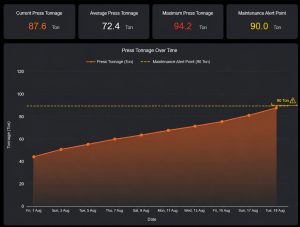
Press tonnage and load signals are not just for catching faults after they happen. Trending them over time is a form of condition monitoring, the practice of tracking equipment health indicators to catch degradation before failure. A press drawing progressively higher tonnage for the same part is often signaling die wear or misalignment well before it causes a tonnage fault or a scrap run, which is what makes industrial IoT for predictive maintenance more useful in a press shop than reactive breakdown response.
Rolling It Into a Shop Floor Machine Management System
A single press’s data is useful. A press shop’s data, covering every press, every die, and every operator on one dashboard, is what actually changes decisions. A shop floor machine management system aggregates monitoring data across every press on the floor, so a plant manager can compare press to press performance, spot which dies are causing the most changeover time, and prioritize maintenance based on actual load trends rather than a fixed calendar schedule. sfHawk’s multi-machine dashboard case study shows this approach in a live production environment.
Get Started Today! Book a call with sfHawk | Email: inquiry@sfhawk.com | Phone: +91 91120 98351 | Website: www.sfhawk.com