A usable Gemba walk checklist organized by safety, quality, flow, machine condition and operator obstacles, plus what not to do.
TL;DR: A Gemba walk is a structured visit to the actual place where work happens (the shop floor, not the conference room) so leaders can observe the process directly, talk to operators, and identify problems firsthand rather than from a report. “Gemba” is Japanese for “the real place.” Done well, it’s a disciplined observation routine, not an informal walkthrough.
Key Takeaways
- Go and see: A Gemba walk means going to observe the actual process, not reviewing it secondhand. The value is in what you see and hear directly.
- Structure beats strolling: A useful walk is structured around categories: safety, quality, flow, machine condition, waiting, and operator obstacles, not an open-ended stroll.
- Observe, don’t inspect: The goal is to ask questions and observe, not to inspect, criticize, or solve problems on the spot.
- Let data point the way: Downtime, output, cycle time, and alarm data can point leaders toward exactly where on the floor to focus a walk.
The Gemba Walk Checklist
Use this checklist as a starting structure, adapting categories to the area being walked.
| Category | What to Look For |
|---|---|
| Safety | Are walkways clear? Is PPE being worn correctly? Are guards and interlocks intact and functioning? |
| Quality | Are in-process checks being performed as specified? Are defective parts identified and segregated visibly? |
| Flow | Is material moving smoothly between stations, or is WIP piling up anywhere? |
| Machine condition | Are there visible leaks, unusual noise, vibration, or overdue maintenance tags? |
| Waiting | Are operators or machines idle waiting on parts, information, or another station? |
| Operator obstacles | What’s slowing the operator down that a standard process doesn’t account for: a missing tool, an awkward reach, unclear instructions? |
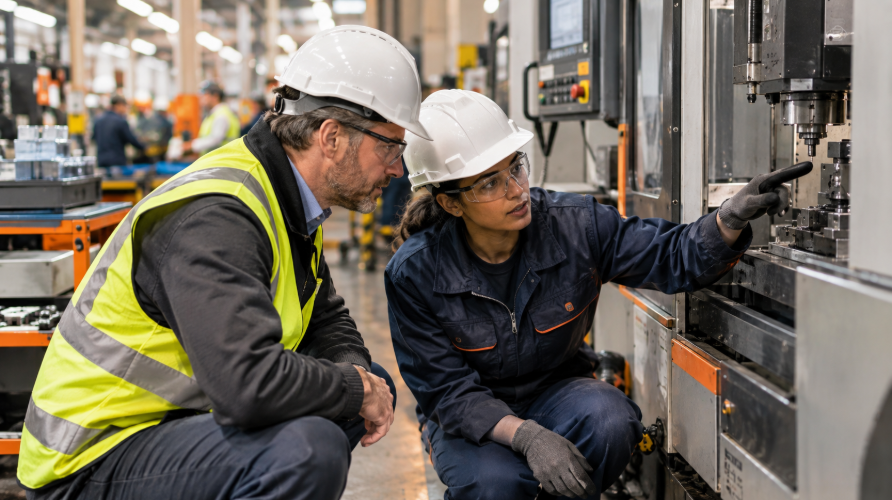
Questions to Ask Operators
| Category | Question to Ask |
|---|---|
| Process | “Walk me through what you’re doing right now, step by step.” |
| Problems | “What slowed you down today, even for a minute?” |
| Standards | “Is this how the process is supposed to be done, or has it changed?” |
| Tools/Materials | “Do you have everything you need within reach when you need it?” |
| Improvement | “If you could change one thing about this station, what would it be?” |
What Not to Do on a Gemba Walk
- Don’t bring a large entourage. It changes how operators behave and answer questions.
- Don’t interrupt to correct or criticize a technique in front of others. Note it and follow up separately.
- Don’t try to solve every problem on the spot. Capture it and assign follow-up instead of improvising a fix.
- Don’t skip the frontline worker to talk only to the supervisor. The person doing the work has the most direct information.
- Don’t treat it as a compliance audit. An audit checks against a standard; a Gemba walk is meant to uncover what the standard doesn’t capture.
“The walk stops being useful the second operators start performing for you instead of just working. If people are cleaning up before you arrive, you’re not seeing the real process anymore; you’re seeing a show.”
Operations Director, industrial manufacturing
“I don’t go to the floor with a clipboard of assumptions. I go with the anomalies from last night’s shift report and ask the operator to show me what happened.”
Shift Supervisor, discrete manufacturing
Using Data to Focus the Walk
A Gemba walk is more productive when it’s not a random sample of the floor. Downtime logs, output trends, cycle-time deviations, and alarm history from the prior shift can tell a leader exactly which line, station, or shift handover is worth walking first, turning a general walkthrough into a targeted investigation.
A platform like sfHawk can surface those anomalies before the walk even starts, so the leader arrives already knowing where output dropped, where alarms clustered, or which shift handover saw the most stoppages, and can use the walk to ask why rather than to discover that something happened at all.
Frequently Asked Questions
How often should a Gemba walk happen?
Many plants run Gemba walks daily for shift leaders and weekly for plant or operations leadership, though frequency should match the pace of the area. A high-variability line benefits from more frequent walks than a stable, low-mix process.
How long should a Gemba walk take?
A focused walk of a single area typically runs 20–45 minutes: long enough to observe a full cycle and talk to a few operators, short enough to stay focused rather than turning into a general tour.
Who should attend a Gemba walk?
Core attendance is usually the area leader plus one or two relevant stakeholders (a quality or maintenance representative, for example), kept small enough that operators keep working naturally rather than treating it as an event.
What’s the difference between a Gemba walk and an audit?
An audit checks a process against a defined standard and produces a pass/fail or compliance score. A Gemba walk is observational and exploratory. Its purpose is to uncover problems, obstacles, and improvement opportunities that a standard checklist wouldn’t necessarily catch.
Related Reading
A Gemba walk is strongest when paired with the data that tells you where to look. See how downtime classification surfaces recurring stoppages, and how shift-level performance reporting highlights handover issues worth walking.
Get Started Today! Book a call with sfHawk | Email: inquiry@sfhawk.com | Phone: +91 91120 98351 | Website: www.sfhawk.com