A decision guide to condition-based, preventive and predictive maintenance, with a comparison matrix, a decision tree and an implementation checklist.
TL;DR: Preventive maintenance services equipment on a fixed schedule. Condition-based maintenance (CBM) acts when a measured indicator shows the asset is deteriorating. Predictive maintenance goes a step further and forecasts when failure will occur. Most plants need a mix, chosen asset by asset according to how each one fails.
Key Takeaways
- The triggers differ: A schedule for preventive, a measured condition for condition-based, a forecast for predictive.
- Predictive is not automatically best: It needs more data, skills and money.
- Condition-based fits gradual wear: Use it when degradation gives a detectable warning before failure.
- Machine data is the input: Machine signals, run hours, alarms and performance trends make condition-driven decisions possible.
Condition-Based vs Preventive vs Predictive Maintenance
| Aspect | Preventive | Condition-based | Predictive |
|---|---|---|---|
| Trigger | Calendar, run hours or cycle count | A measured indicator crosses a threshold | A forecast of when the indicator will reach a failure level |
| Data needs | Maintenance history, OEM intervals | Live signals such as vibration, temperature, spindle load, tool wear | Long condition and failure history, plus models |
| Cost | Low | Moderate: sensors and connectivity | Highest: data, analytics and skills |
| Complexity | Low | Medium | High |
| Best-fit assets | Predictable wear, low-cost parts, regulatory checks | Critical assets that degrade gradually with a detectable warning | High-value assets with costly failures and long parts lead times |
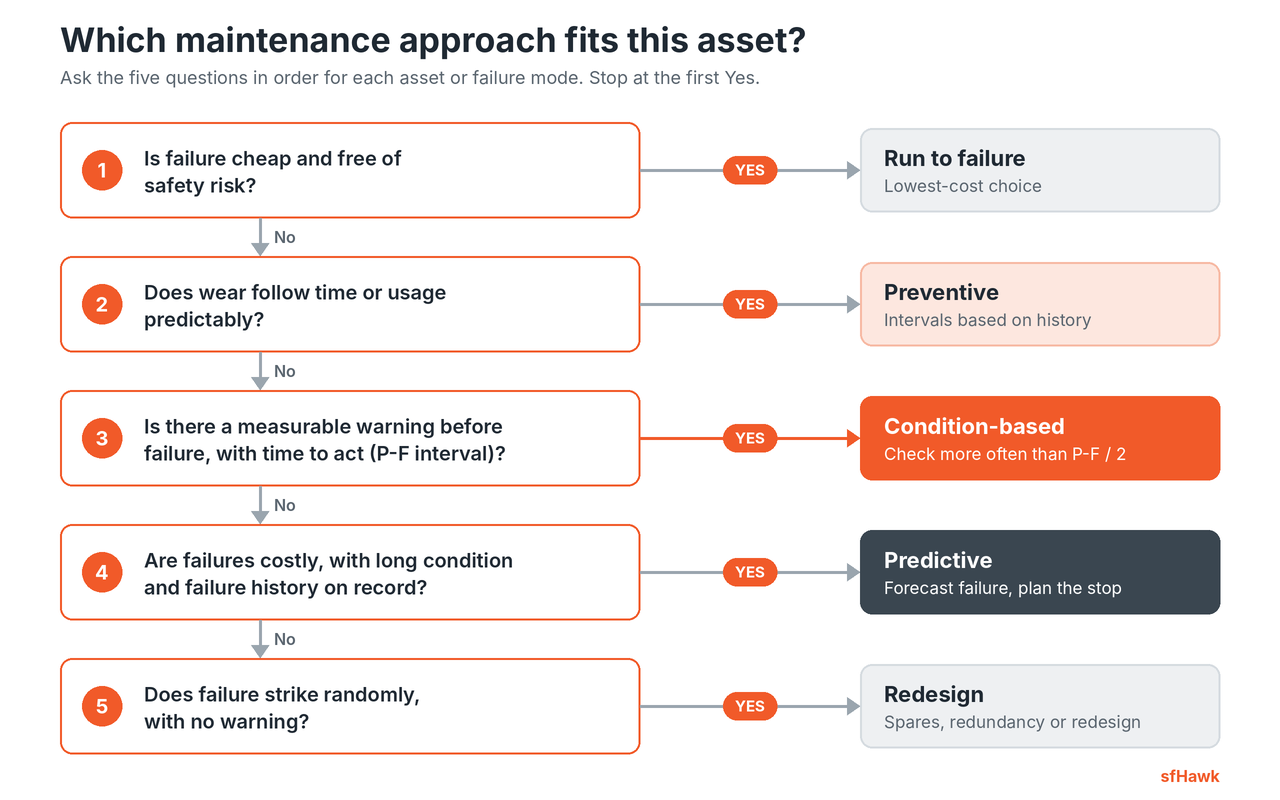
Which Maintenance Approach Should You Use?
Work through these questions for each asset or failure mode:
- Is failure cheap and free of safety risk? Running to failure may be the lowest-cost choice.
- Does wear follow time or usage predictably? Use preventive maintenance, with intervals based on history.
- Does the asset show a measurable warning before failure, with enough lead time to act? That lead time is the P-F interval. Use condition-based maintenance and check more often than half of it.
- Are failures costly, and do you hold long records of condition and failure data? Consider predictive maintenance.
- Does failure strike randomly, with no warning? Monitoring will not help. Look at spares, redundancy or redesign.
Condition-Based Maintenance Examples in a Machine Shop
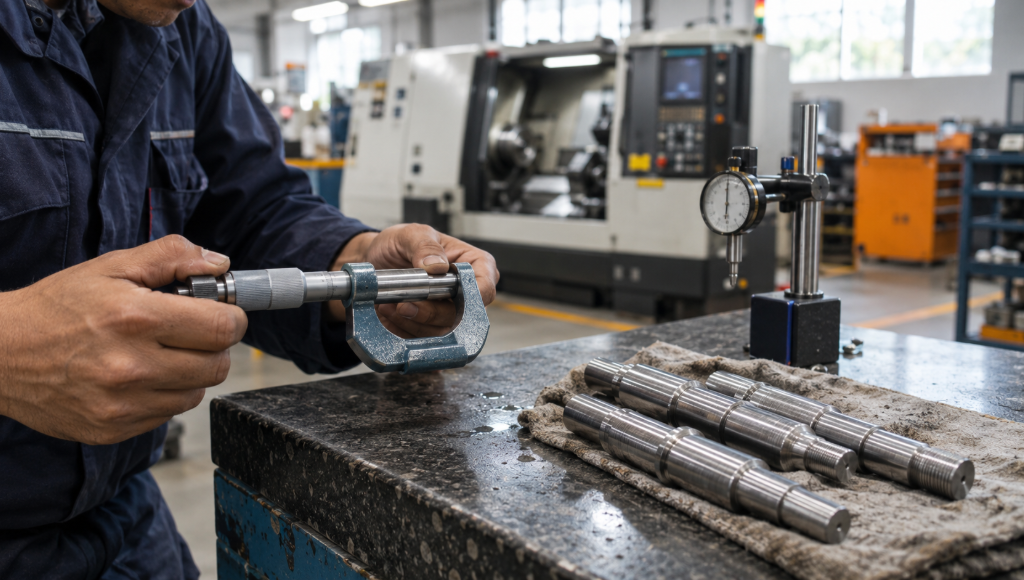
- Preventive: Change coolant and filters every 500 run hours, grease slideways monthly, calibrate gauges every year.
- Condition-based: Inspect a spindle bearing when vibration passes a set limit above its baseline, change a tool at its wear threshold, check the hydraulic unit when oil temperature trends high.
- Predictive: Trend spindle bearing vibration over months, forecast when it will reach the alarm level, and order the bearing and book a planned stop before then.
Choosing Per Asset with Reliability Centered Maintenance
Reliability centered maintenance (RCM), standardized in SAE JA1011, formalizes this choice. It asks what each asset does, how it can fail and what the consequences are, then assigns the least costly task that is technically worthwhile. That is why one plant can use all of these strategies at once.
“Predictive maintenance gets all the attention, but for most of our machines a simple threshold on a signal we already collect is cheaper and just as effective. The model only earns its cost on the few assets where failure is very expensive.”
[Name], [Designation], [Company]
Condition-Based Maintenance Implementation Checklist
- Rank assets by criticality: Use downtime cost and failure history.
- Map failure modes to signals: List the failure modes for each asset and the signal each one shows first.
- Record baselines first: Capture readings during normal running before setting thresholds.
- Check signal quality and ownership: Agree who responds to an alert and how fast.
- Bridge with run hours: Use run hours for assets that are not yet instrumented.
- Review every quarter: Compare thresholds and results against unplanned downtime and MTBF.
Machine Data as the Input
Condition-driven decisions need evidence. sfHawk collects machine signals such as spindle load, tool life, vibration and temperature where available, along with run hours, alarms and performance trends through machine monitoring software.
Alerts fire when a reading leaves its defined range, and the Preventive Maintenance module in condition monitoring and preventive maintenance software can schedule service from condition data instead of a fixed calendar. The analytics platform adds AI-based predictions for teams ready to forecast. Start with the machines whose failures cost the most.
Frequently Asked Questions
What is the difference between condition-based maintenance and predictive maintenance?
Condition-based maintenance triggers action when a measured indicator crosses a threshold. Predictive maintenance adds a forecast of when the indicator will reach a failure level. EN 13306 treats predictive maintenance as a form of condition-based maintenance driven by that forecast.
Do run-hour triggers count as condition-based maintenance?
No. Run hours measure usage, not condition, so a run-hour trigger is usage-based preventive maintenance. It is a useful step up from calendar intervals and a good bridge, but it does not tell you how the asset is actually wearing.
Preventive vs predictive maintenance: what is the difference?
Preventive maintenance follows a fixed interval, which can replace parts too early or miss random failures. Predictive maintenance forecasts the right moment from degradation data, but needs more data and expertise.
References: EN 13306, Maintenance terminology; SAE JA1011, Evaluation Criteria for RCM Processes; ISO 17359, Condition monitoring and diagnostics of machines.
Related Reading
Maintenance decisions are only as good as the machine data behind them. See how condition monitoring and preventive maintenance software schedules service from real readings, and how machine monitoring software captures run hours, alarms and signals by machine. For the wider picture, read How Industrial IoT Drives Predictive Maintenance, The 8 Pillars of TPM, MTBF, MTTR and MTTF Explained, and Spindle Load in CNC Machines.
Get Started Today! Book a call with sfHawk | Email: inquiry@sfhawk.com | Phone: +91 91120 98351 | Website: www.sfhawk.com