What jidoka means, its four steps, how it differs from Poka Yoke and Andon, and examples beyond Toyota.
TL;DR: Jidoka is the lean principle of building quality into the process by giving machines and people the ability to detect an abnormality and stop immediately. It is often translated as automation with a human touch. The aim is to keep defects from moving downstream and to fix the cause as well as the part.
Key Takeaways
- A fixed sequence: Jidoka follows detect, stop, signal, fix, and prevent recurrence.
- A principle, not a machine: It applies to manual lines as much as automated ones.
- Three tools, one discipline: Poka Yoke prevents or catches an error, Andon signals the problem, and jidoka is the discipline that ties the response together.
- Process decides the result: Technology can surface abnormal conditions faster. The operating process decides whether anything improves.
How Jidoka Works
The idea comes from Sakichi Toyoda’s automatic looms, which stopped by themselves when a thread broke. One person could then supervise many looms without producing yards of faulty cloth. Toyota later applied the same logic across production and called it autonomation, short for autonomous automation. In lean manufacturing, jidoka is one of the two pillars of the Toyota Production System, alongside just-in-time.
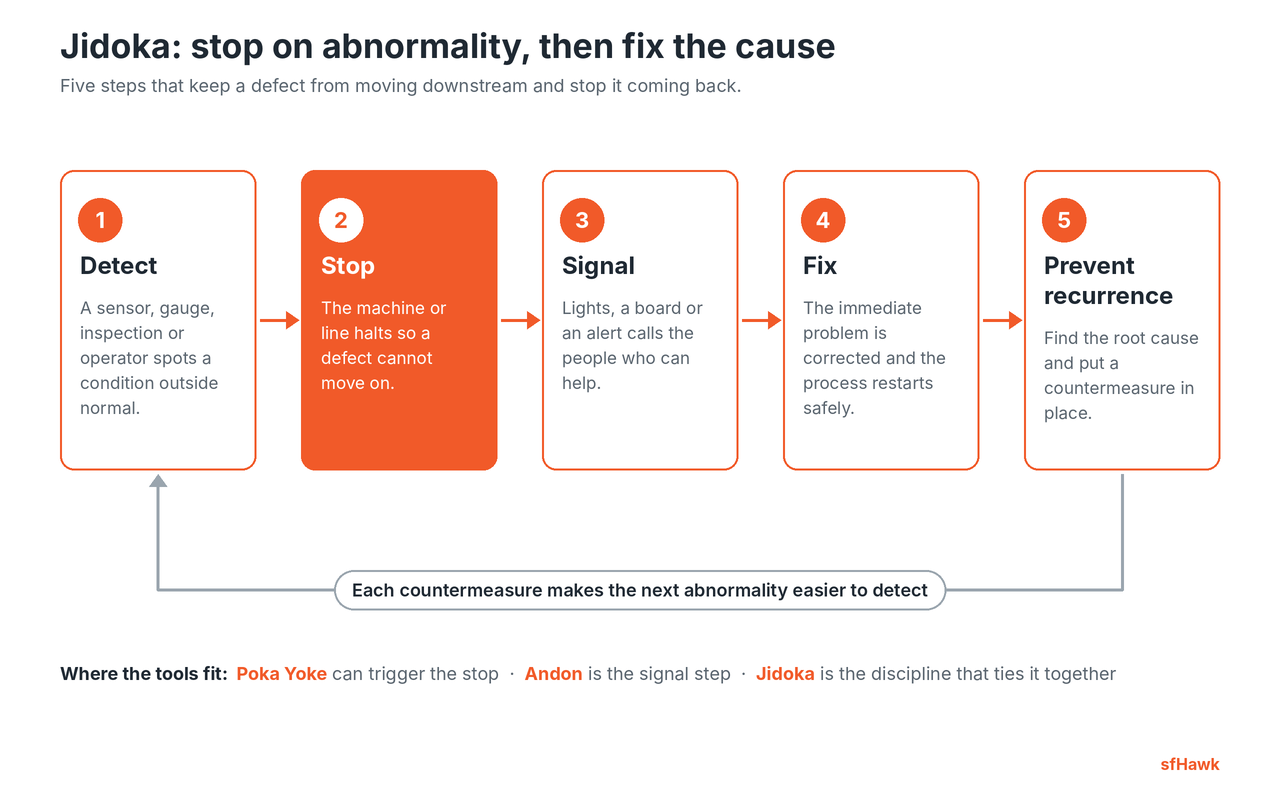
- Detect the abnormality: A sensor, gauge, inspection or operator spots a condition outside normal.
- Stop the line: The machine or line halts so a defect cannot move on.
- Signal: Lights, a board or an alert calls the people who can help.
- Fix: The immediate problem is corrected and the process restarts safely.
- Prevent recurrence: The root cause is investigated and a countermeasure is put in place.
Jidoka vs Poka Yoke vs Andon
| Aspect | Jidoka | Poka Yoke | Andon |
|---|---|---|---|
| What it is | A principle: stop on abnormality, then fix the cause | A device or method that prevents or detects a specific error | A signaling system that shows a problem and calls for help |
| Question it answers | What happens when something goes wrong? | How do we stop this error from happening or moving on? | Who needs to know right now? |
| Example | A machine halts when spindle load passes a limit | A fixture that accepts a part only one way round | A light turns red and the supervisor is alerted |
| Relationship | The umbrella principle | Can trigger a jidoka stop | The signal step within jidoka |
Jidoka Examples Beyond Toyota
- CNC machining: A tool-life or spindle-load limit stops the machine before a worn or broken tool ruins the part.
- Assembly: A torque tool checks torque and angle, and the station stops and alerts if the result falls outside its window.
- Injection molding: Mold protection halts the cycle when a part sticks, avoiding tool damage.
- Packaging: A vision system rejects defects and stops the line after repeated failures.
- Manual lines: An operator pulls a stop cord when a defect appears and the team leader responds.
“Every stop feels like lost output until you count what a defect costs three stations later. Plants that stop early almost always end up producing more good parts per shift.”
[Name], [Designation], [Company]
Where Jidoka Breaks Down in Practice
- No authority to stop: Operators are not given the authority to stop, or are quietly penalized for doing so.
- Alerts without follow-up: Alerts are acknowledged but not investigated, so the same stop repeats every week.
- Vague stop reasons: Stops are logged as “other,” so patterns never become visible.
- Part fixed, cause ignored: The line stops but recurrence is never prevented.
Recording every stop with a reason is what turns an interruption into learning. It also shows which stops are worth designing out first.
Real-Time Alerts and the Lean Principle
Detection is where technology helps most. Alerts built on machine and process data reach the right person within moments instead of at the end of a shift. sfHawk lets teams set limits for key parameters and sends alerts when a reading leaves them, covering signals such as spindle load, tool wear, temperature and downtime through machine monitoring software. Vajra can also support machine interlocks, so selected operations do not continue when defined conditions are not met.
Software is not jidoka, though. The principle lives in the operating process around it: who is allowed to stop the line, who responds, how quickly, and how the root cause is recorded. Without that, an alert is only a faster notification.
Frequently Asked Questions
What are the four steps of jidoka?
The commonly cited four steps are to detect the abnormality, stop, fix or correct the immediate condition, and investigate the root cause to install a countermeasure. Some versions add a signal step between stop and fix, which is where Andon fits.
Is jidoka automation?
Not exactly. It is often called automation with a human touch: machines detect and stop, and people respond. The principle works on manual lines too. A fully automated line without a stop-and-fix discipline is not practicing jidoka.
References: Ohno, Toyota Production System: Beyond Large-Scale Production (1988); Liker, The Toyota Way (2004); Toyota Motor Corporation, Toyota Production System overview.
Related Reading
Stopping on abnormality only works when every stop is seen and recorded. See how machine monitoring software captures run, stop and alarm states by machine, and how production monitoring software tracks output by shift. For the wider picture, read Poka Yoke in Manufacturing: Error-Proofing at the Source, Manufacturing Process Monitoring Software, Machine Downtime Tracking Software, and How to Run a Gemba Walk.
Get Started Today! Book a call with sfHawk | Email: inquiry@sfhawk.com | Phone: +91 91120 98351 | Website: www.sfhawk.com