The lean framework behind the 7/8 wastes, and why eliminating waste alone doesn’t work without fixing unevenness and overload first.
TL;DR: Muda, Mura and Muri (the “3Ms”) are the three root causes of waste in lean manufacturing. Muda is waste itself, Mura is unevenness or inconsistency in a process, and Muri is overburden on people or equipment. The three are linked: unevenness (Mura) creates overload (Muri), and overload creates waste (Muda). That is why fixing waste without addressing the other two rarely holds.
Key Takeaways
- The 3Ms are cause and effect: Muda (waste), Mura (unevenness) and Muri (overburden) are linked, not three unrelated categories.
- The 7/8 wastes sit inside Muda: They are specific forms of Muda, and the 3Ms are the broader framework they belong to.
- Fix the cause, not just the symptom: Removing a visible waste without addressing the Mura or Muri behind it usually means the waste comes back in a different form.
- Data makes Muda visible: Machine and production data directly expose waiting, overproduction, uneven utilization and micro-stops.
Muda, Mura and Muri: Definitions and Examples
| Term | Meaning | Symptoms | Factory Example |
|---|---|---|---|
| Muda (waste) | Any activity that consumes resources without adding value | Excess inventory, idle time, defects, unnecessary motion | Parts sitting in a WIP buffer for two days before the next operation |
| Mura (unevenness) | Inconsistency or variation in workload, pace, or quality | Some stations swamped while others wait; output that swings shift to shift | One line running at full tilt while the adjacent line sits idle for parts |
| Muri (overburden) | Pushing people or equipment beyond a reasonable or sustainable limit | Rushed changeovers, skipped checks, excessive overtime, equipment run past rated capacity | A machine run continuously above its rated speed to hit a rush order |
How the 3Ms Cause Each Other
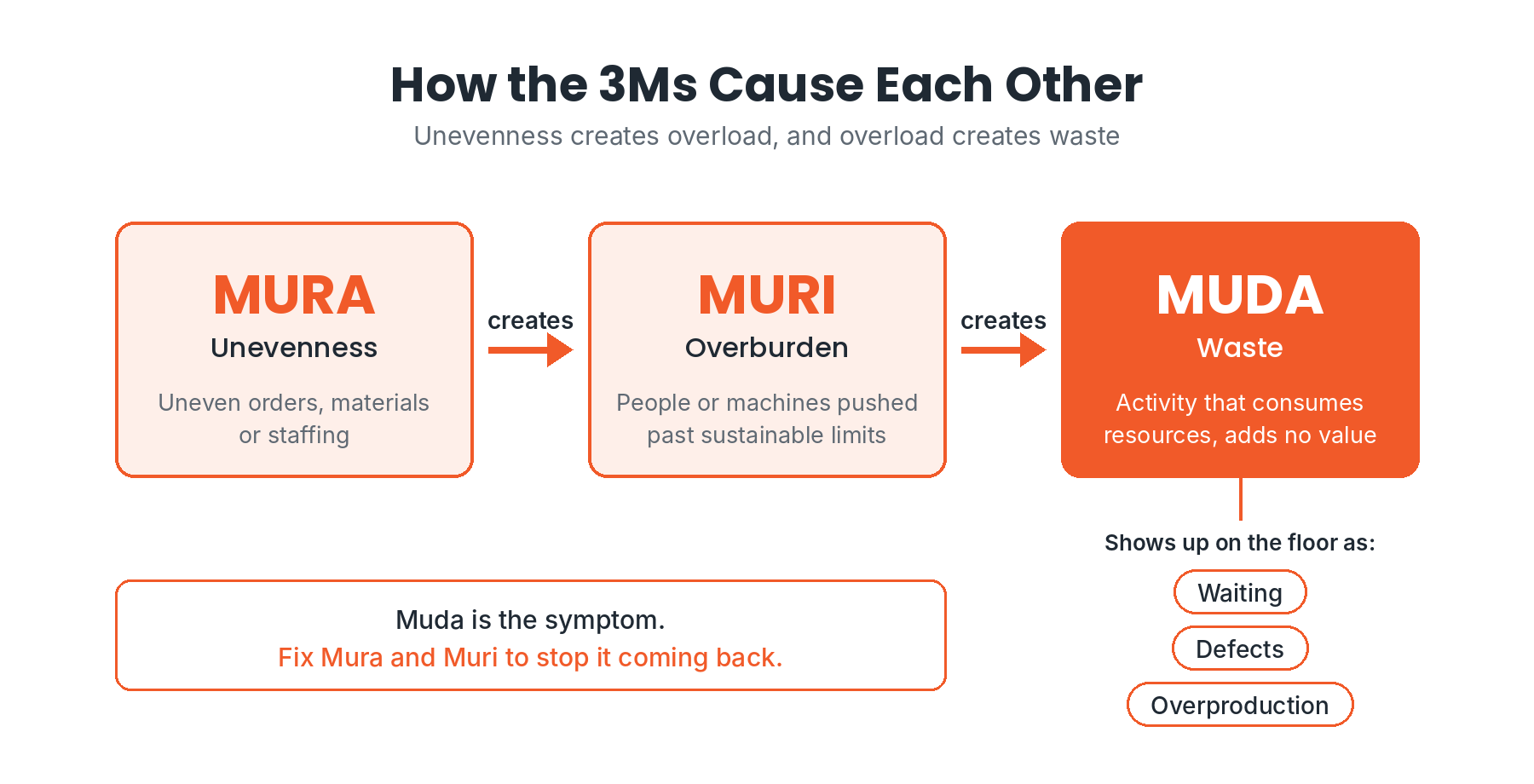
The three rarely appear in isolation. Mura, an uneven flow of orders, materials, or staffing, forces some stations into Muri: working faster or longer than they’re built for to keep pace. That overburden produces Muda: defects from rushed work, breakdowns from equipment pushed too hard, or idle time on the stations that were left waiting.
Treating the resulting waste as the problem, without touching the unevenness that caused the overload, is why the same waste often reappears a few weeks after a cleanup event. This is also why the Toyota Production System, where the 3Ms originated, puts so much weight on leveling production, known as heijunka, rather than only removing visible waste.
Mapping the 7/8 Wastes to the 3Ms
The 7 wastes (an 8th, underutilized talent, is often added, as in ASQ’s DOWNTIME model) are specific expressions of Muda. Each can usually be traced back to a Mura or Muri root cause:
| Waste (Muda) | Typical Root Cause |
|---|---|
| Waiting | Mura: uneven pace between upstream and downstream stations |
| Overproduction | Muri: running equipment past demand to avoid a changeover or perceived risk of shortage |
| Excess inventory | Mura: inconsistent order patterns causing buffer stock to build unevenly |
| Defects | Muri: process or people pushed faster than the quality standard allows |
| Unnecessary motion | Mura: inconsistent workstation layout or standard work |
| Excess transportation | Mura: uneven or unplanned material flow between areas |
| Over-processing | Muri: equipment or steps used beyond what the specification actually requires |
| Underutilized talent | Mura: skills and staffing not matched consistently to where the work is |
Mini Case Scenarios
- Machine waiting for material: An upstream station runs inconsistently (Mura), so the downstream machine sits idle some hours and is flooded with WIP others. Waiting waste (Muda) shows up on paper, but the fix is stabilizing the upstream pace, not speeding up the idle machine.
- One line overloaded while another is idle: Uneven order allocation (Mura) pushes one line into overtime and equipment strain (Muri), while a second line sits underused. Rebalancing the schedule fixes it faster than adding capacity to the overloaded line.
- Rush order pushes a machine past rated speed: A single Muri event (running hot to hit a deadline) produces a defect spike and an unplanned breakdown days later. That Muda gets logged as a quality or maintenance issue, when the actual cause was the overload decision upstream.
“You can run a kaizen event, remove the waste you can see, and watch it come back in three months if you never touched the unevenness or overload that produced it in the first place. Muda is the symptom. Mura and Muri are where the real fix usually is.”
Continuous Improvement Manager, automotive supplier
Where Data Makes the 3Ms Visible
Mura and Muri are harder to spot than Muda because they’re about pattern and load, not a single visible pile of inventory. Continuous production monitoring makes several of the underlying wastes directly measurable:
- Waiting shows up as idle time between cycles.
- Overproduction shows up as output exceeding schedule.
- Uneven utilization shows up as a gap between two lines’ output over the same period.
- Micro-stops and excess processing show up as cycle-time patterns that a single floor observation would likely miss.
Muri can be tracked the same way. Condition monitoring flags equipment running past its limits, as in this spindle load management case study. That visibility is what turns “this line seems busier than that one” into a measured Mura pattern worth acting on.
Frequently Asked Questions
What’s the difference between the 3Ms and the 7 or 8 wastes?
The 3Ms (Muda, Mura, Muri) are the framework describing waste, its causes, and its conditions. The 7 or 8 wastes are specific categories of Muda itself, the concrete forms waste takes on the floor, such as waiting, overproduction, or defects. The wastes sit inside the 3M framework rather than replacing it.
Is Muda the same thing as the 7 wastes?
Muda is the broader term for waste in general; the 7 (or 8) wastes are the standard categorized list of the specific forms Muda commonly takes in manufacturing. Every one of the 7 wastes is a type of Muda, but Muda as a concept isn’t limited to only those categories.
Why address Mura and Muri instead of just removing waste directly?
Removing a visible waste without fixing the unevenness or overload that caused it usually treats the symptom rather than the source. The same or a related waste tends to reappear elsewhere in the process once conditions shift again.
Related Reading
Spotting Mura and Muri patterns depends on visibility into how work actually flows. See how OEE breaks down speed and availability losses, and how cycle-time monitoring reveals the micro-stops that a single walkthrough tends to miss. For a deeper grounding in the terms themselves, the Lean Enterprise Institute’s lexicon is a useful reference.
Get Started Today! Book a call with sfHawk | Email: inquiry@sfhawk.com | Phone: +91 91120 98351 | Website: www.sfhawk.com