The takt time formula, a worked factory example, and what it actually means when your cycle time doesn’t match it.
TL;DR: Takt time is the maximum time allowed to produce one unit in order to meet customer demand, calculated as available production time divided by customer demand. It is a pacing target set by demand, not a measure of how fast a machine can run. That is cycle time, a related but distinct metric covered below.
Key Takeaways
- Takt time = Available Production Time ÷ Customer Demand: It tells you the required pace, not the actual one.
- Cycle time vs takt time: Cycle time is how long a process actually takes; takt time is how long it is allowed to take to meet demand.
- A gap means action: When cycle time exceeds takt time, the line can’t meet demand without overtime, added capacity, or a process fix.
- Takt is recalculated, not fixed: It changes whenever demand or available time changes, and should never be treated as a machine-speed target.
The Takt Time Formula
The concept comes from the Toyota Production System, and the Lean Enterprise Institute defines it in the same way. Takt time is calculated as:
Takt Time = Available Production Time ÷ Customer Demand
Worked example: a line runs one 8-hour shift (480 minutes), with 30 minutes of scheduled breaks, leaving 450 minutes of available production time. Customer demand is 300 units per day.
Takt Time = 450 minutes ÷ 300 units = 1.5 minutes per unit
That means the line needs to complete one unit every 1.5 minutes to meet the day’s demand. Not as fast as possible, just fast enough, consistently.
Takt Time vs Cycle Time vs Lead Time
| Metric | What It Measures | Set By | Example |
|---|---|---|---|
| Takt Time | The pace required to meet customer demand | Customer demand | 1.5 min/unit required |
| Cycle Time | The actual time a process takes to complete one unit | The process itself | 1.7 min/unit actual |
| Lead Time | Total time from order/start to finished, delivered unit | The full process, including wait and queue time | 3 days from raw material to shipment |
Takt and cycle time are both per-unit measures and are directly comparable. Lead time operates on a different scale entirely: it includes every wait, queue, and handoff between steps, not just the value-added processing time. A takt time vs lead time comparison is really a comparison of two different planning horizons. One paces a single station, the other measures the full order-to-delivery journey.
What It Means When Cycle Time Misses Takt
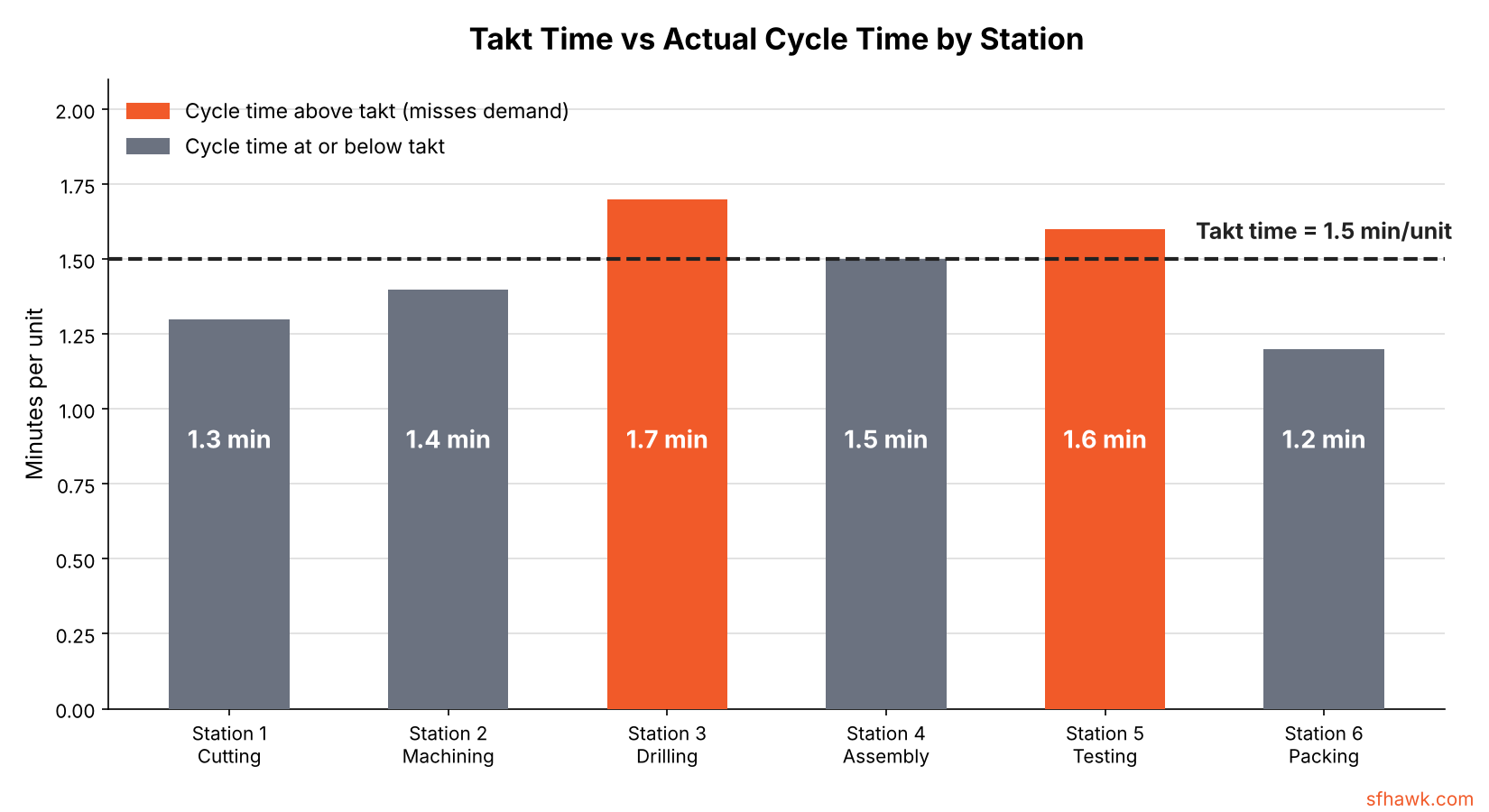
- Cycle time above takt time: The line is running slower than demand requires. Orders will fall behind unless overtime, extra shifts, or a process fix close the gap.
- Cycle time equal to takt time: The line matches demand exactly, but has zero buffer for downtime, changeovers, or variation. It is a fragile balance.
- Cycle time below takt time: The line is faster than demand requires. That can mean healthy slack, or overproduction if operators keep running at full speed anyway.
- No defined cycle time yet (new product introduction): The target is set first, and the process is designed or adjusted to hit it before full production ramp-up.
“Takt gets misused the moment someone posts it on the wall as a speed target. It’s a pacing tool for balancing the line, not a stopwatch for pushing operators harder than demand actually requires.”
Production Manager, contract manufacturing
Comparing Actual Cycle Time to Required Takt
The formula is simple; the hard part is knowing, station by station, whether the line is actually hitting it. A takt calculation done once a quarter doesn’t catch a station that has been running 10% slow for the past three shifts.
Real-time cycle-time monitoring closes that gap by continuously comparing actual cycle performance against the required takt and flagging exactly which machine or process is causing a miss, rather than leaving the team to infer it from a missed shipment days later. Continuous production monitoring turns takt time from a planning number into an operating signal. A real example is this spindle load management case study, where cycle time was improved by acting on live machine data.
When a gap does show up, it is often a scheduling problem as much as a machine problem. Rebalancing setups and the production schedule can recover lost pace without adding capacity.
A Note on Pitch Time
Pitch time is a related concept: takt time multiplied by the pack-out quantity, used when product moves in batches (for example, a case of 10 units) rather than one at a time. It sets the pace for batch movement rather than individual-unit completion, and is most relevant in pull and kanban systems.
Frequently Asked Questions
How do you calculate takt time?
Divide the available production time (shift time minus planned breaks and stoppages) by customer demand for the period. For example, 450 available minutes ÷ 300 units of demand = 1.5 minutes of takt time per unit.
Can takt time change daily?
Yes. Takt time is recalculated whenever available time or customer demand changes, which can happen daily if demand fluctuates or shift schedules vary. Some plants recalculate takt weekly or per production run rather than daily, depending on how stable demand is.
What happens if cycle time exceeds takt time?
The process is running slower than required to meet demand, which means orders will fall behind unless the gap is closed through overtime, added capacity, a second shift, or fixing the bottleneck causing the slow cycle. Left unaddressed, it shows up downstream as missed shipments.
Related Reading
Takt time is only actionable when it is compared against real cycle-time data. See how value stream mapping captures cycle time station by station, and how OEE monitoring and condition monitoring explain why a station is missing its required pace. For wider context on the waste behind slow cycles, see the ASQ lean resources.
Get Started Today! Book a call with sfHawk | Email: inquiry@sfhawk.com | Phone: +91 91120 98351 | Website: www.sfhawk.com