Poka Yoke in Manufacturing: A Practical Guide
A practical guide to mistake-proofing on the shop floor — what it is, how it works, and how real-time data helps it catch more before a defect ships.
TL;DR: Poka Yoke is a lean manufacturing technique that designs a process, tool, or fixture so a mistake either cannot be made or is caught immediately if it is. Developed by Shigeo Shingo at Toyota, it aims to eliminate defects at the source rather than inspect for them afterward — using simple, low-cost mechanisms rather than added inspection labor.
Key Takeaways
- Mistake-proofing by design: Poka Yoke designs the process so an error either can’t happen (prevention) or is caught the moment it does (detection).
- Prevention beats detection: Prevention-type devices are generally preferred; detection-type devices are the fallback when prevention isn’t physically or economically possible.
- A core lean tool: Poka Yoke is one of the core tools inside lean manufacturing and the Toyota Production System, closely tied to jidoka.
- Data shows where it’s needed: Real-time machine and quality monitoring helps teams find where a new Poka Yoke device is needed, and confirms existing ones are still working.
What Poka Yoke Actually Means
“Poka Yoke” (pronounced POH-kah YOH-keh) combines the Japanese words for “inadvertent error” and “prevent.” The idea is simple: humans and machines will always make mistakes occasionally, so the smartest fix is to design the process so that mistake either can’t happen, or gets flagged before it turns into a defect, a safety incident, or scrap.
Poka Yoke devices are usually mechanical, visual, or sensor-based rather than procedural. A part that only fits one way, a fixture that won’t close unless every component is present, a light curtain that stops a press if a hand crosses into the danger zone — these are all Poka Yoke in action. The goal is to make the correct action the only possible action, or the easiest one.
Prevention vs Detection: The Two Types of Poka Yoke
Every Poka Yoke mechanism falls into one of two categories, depending on when it intervenes in the process.
| Type | When It Acts | How It Works | Example |
|---|---|---|---|
| Prevention (Control) | Before the error occurs | Physically stops the wrong action from happening at all | Asymmetrical connector that only mates one way |
| Detection (Warning) | Immediately after the error occurs | Flags or halts the process so the error is caught before it moves downstream | Weight sensor that alerts if a component is missing from an assembly |
Prevention-type devices are generally preferred because they remove the possibility of error entirely. Detection-type devices are a strong second choice when prevention isn’t physically or economically feasible — they still stop a defect from reaching the next station or the customer.
Real Manufacturing Examples of Poka Yoke
These examples span industries, but the underlying logic is the same in every case: make the mistake visible or impossible.
| Industry | Problem | Poka Yoke Mechanism | Result |
|---|---|---|---|
| Automotive assembly | Bolts left untightened on a subassembly | Torque wrench that won’t release from its holster until the correct count is reached | Zero missed-fastener escapes |
| Electronics | Connector plugged in backward, damaging pins | Keyed, asymmetric connector housing | Physically impossible to reverse |
| Packaging | Wrong label applied to a product line | Barcode scanner that locks the line if the scanned label doesn’t match the work order | Mislabeling caught at the source |
| Injection molding | Short-shot (underfilled) parts shipped | In-mold pressure sensor that rejects the part automatically if pressure falls below threshold | Defective parts never reach packing |
| Food processing | Foreign object contamination | Metal detector with automatic reject arm on the conveyor | Contaminated product removed before palletizing |
| Medical devices | Incomplete kit shipped to a hospital | Shadow-board fixture where every tool and component has a dedicated cutout | Missing items are visually obvious before the tray is closed |
Problem → Mistake-Proofing Mechanism → Result
Stripped down, every Poka Yoke initiative follows the same three-step logic, which makes it a useful framework for designing your own:
| 1. Problem | 2. Mechanism | 3. Result |
|---|---|---|
| Operator forgets a process step | Sequential interlock — next station won’t activate until the prior step is confirmed | Step cannot be skipped |
| Wrong part variant picked from a shared bin | Sensor-triggered pick-to-light system | Only the correct part location lights up |
| Dimension drifts outside tolerance during a long run | In-line gauge with automatic stop on out-of-spec reading | Drift caught within one cycle, not one shift |
Where Digital Monitoring Complements Physical Mistake-Proofing
Physical Poka Yoke devices are excellent at stopping a specific, known failure mode. Their limitation is that someone has to identify that failure mode first — usually after it has already happened a few times. This is where real-time machine and quality data closes the gap.
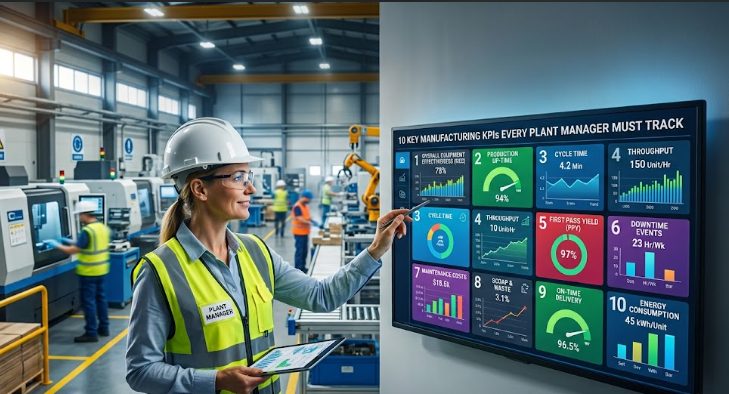
A monitoring platform like sfHawk sits on top of the process and continuously tracks machine cycles, quality readings, and downtime events. Instead of waiting for a defect trend to surface in a monthly report, teams can see a process deviation — a cycle time drifting, a reject rate climbing on a specific station, a recurring stoppage pattern — as it happens. That visibility does two things for a Poka Yoke program: it points engineers toward where a new mistake-proofing device is actually needed, and it verifies that an existing Poka Yoke is still doing its job rather than being bypassed or wearing out.
“The mechanism only works if it’s still active on the line six months later. We’ve seen fixtures get bypassed under production pressure — the data is what tells you it happened.”
— Production Quality Lead, discrete manufacturing
How to Implement Poka Yoke on Your Line
A basic implementation sequence that holds up across industries:
- Identify the failure mode — from defect logs, scrap data, or near-miss reports.
- Trace it to its root cause — not just where it was caught, but where it originated.
- Choose prevention if physically possible — fall back to detection if not.
- Pilot the mechanism on one line or one shift before rolling it out.
- Track the defect rate and downtime impact after implementation to confirm it worked.
- Review periodically — mechanisms wear, get bypassed, or become irrelevant as products change.
Frequently Asked Questions
What are the types of Poka Yoke?
Poka Yoke devices fall into two functional types: prevention (control), which physically stops an error from occurring, and detection (warning), which flags or halts the process immediately after an error occurs. Prevention is generally preferred when it’s feasible.
Is Poka Yoke part of lean manufacturing?
Yes. Poka Yoke is one of the core tools within the Toyota Production System and the broader lean methodology, specifically supporting the goal of building quality into the process (jidoka) rather than inspecting for it afterward.
Poka Yoke vs Jidoka – what’s the difference?
Jidoka is the broader principle of giving machines and people the ability to stop production the moment an abnormality occurs. Poka Yoke is one of the specific mechanisms used to achieve that the physical or sensor-based device that detects or prevents the error in the first place.
Related Reading
Poka Yoke works best alongside broader quality and monitoring practices. Explore how statistical process control (SPC) catches drift before it becomes a defect, how machine monitoring gives engineering teams the data to know where mistake-proofing is needed most, and how FMEA and PFMEA rank which failure modes to mistake-proof first.
Get Started Today! Book a call with sfHawk | Email: inquiry@sfhawk.com | Phone: +91 91120 98351 | Website: www.sfhawk.com