A plain explanation of OPC UA: architecture, key terms, security, and how it compares with MQTT and MTConnect.
TL;DR: OPC UA (Open Platform Communications Unified Architecture) is a platform-independent standard, published as IEC 62541, for exchanging industrial data securely between machines, controllers and software. It defines how data is described, accessed and protected, so equipment from different vendors can be read in a consistent way.
Key Takeaways
- More than a protocol: OPC UA covers transport, security and a data model.
- No internet needed: It runs on ordinary plant networks.
- Not rivals: OPC UA, MQTT and MTConnect solve different problems and often sit together in one architecture.
- Mixed floors need mixed methods: Use OPC UA for the machines that offer it and other methods for the rest.
How OPC UA Works
A machine controller or PLC holds the data. An OPC UA server exposes it as nodes in an address space. A client, such as an edge device, gateway or software application, connects to the server, browses the nodes, and reads values, subscribes to changes, writes values or calls methods. Applications such as monitoring, MES and ERP then use the data.
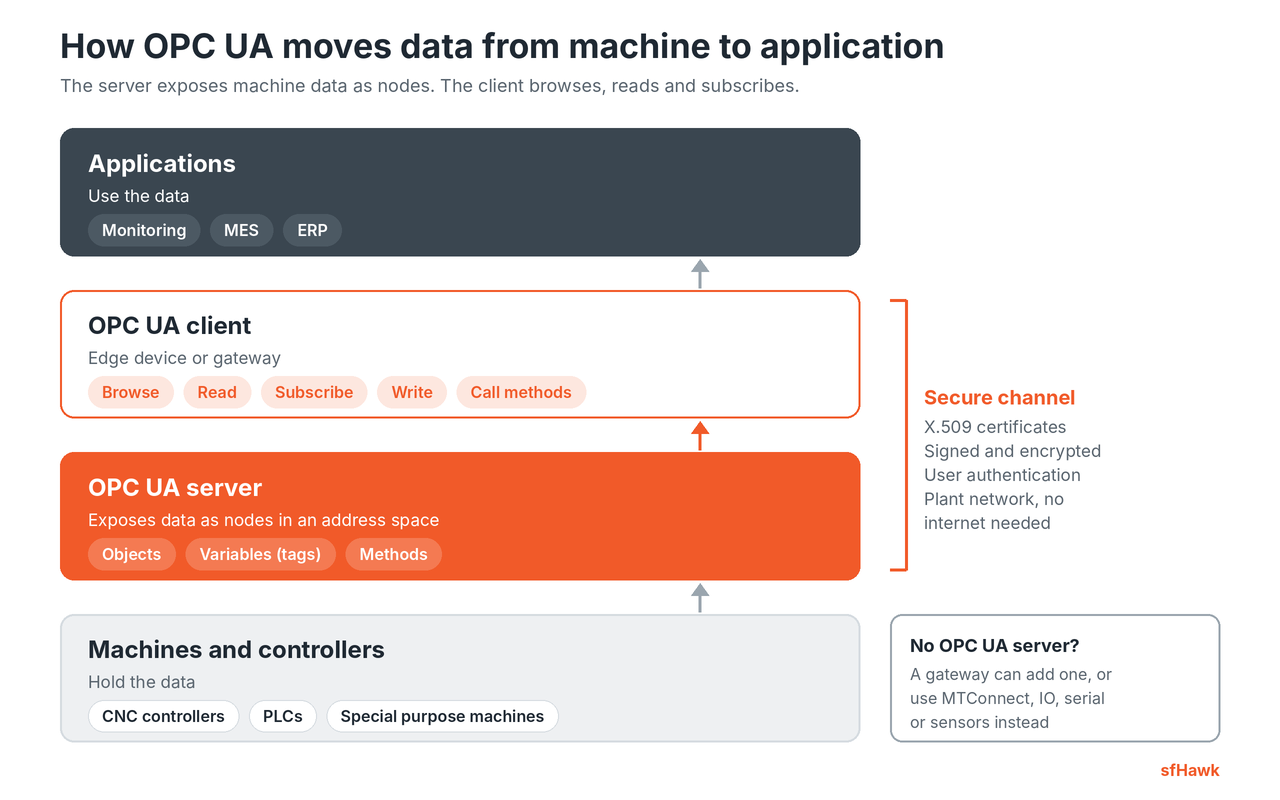
Many modern controllers include an OPC UA server. Where one is missing, a gateway can add it, or another connection method is used.
OPC UA Terms in Plain Language
| Term | Meaning |
|---|---|
| Server | Software that exposes machine data and services, often inside a controller |
| Client | Software that connects to a server to read, write or subscribe to data |
| Node | Any item in the server’s address space: an object, a variable or a method |
| Tag | Everyday name for a variable node that holds a value, such as spindle speed |
| Information model | The structure that describes what nodes mean and how they relate, including industry companion specifications |
| Security | X.509 certificates to identify applications, signed and encrypted messages, user authentication |
Interoperability and Security
Companion specifications, developed with industry groups, define standard data models for many equipment types, including machine tools. A value such as spindle speed then means the same thing across vendors. Servers can also expose vendor-specific data.
Client and server identify each other with X.509 certificates, set up a secure channel, and can sign and encrypt traffic. Users can be authenticated, and security events can be audited. Security still depends on configuration. A server left on default settings, or with security turned off, offers little protection.
“The value of OPC UA is not that every machine speaks it the same way on day one. It is that the data means the same thing once you connect, and that security is part of the standard instead of an afterthought.”
[Name], [Designation], [Company]
OPC UA vs MQTT and OPC UA vs MTConnect
OPC UA vs MQTT
| Aspect | OPC UA | MQTT |
|---|---|---|
| What it is | Interoperability standard with data model, security and services | Lightweight publish and subscribe messaging protocol |
| Data model | Built in | None. Payloads are defined by the user or add-ons such as Sparkplug B |
| Typical role | Reading and structuring data at the machine or line | Moving data between systems and to the cloud |
OPC UA vs MTConnect
| Aspect | OPC UA | MTConnect |
|---|---|---|
| Scope | Any industrial equipment | Machine tools and manufacturing equipment |
| Direction | Read, write and call methods | Designed to read data out of machines |
| Format | Binary and other encodings | XML or JSON over HTTP |
They are not rivals. OPC UA PubSub is not tied to one messaging system and can use MQTT as a transport, and the OPC Foundation and MTConnect Institute have worked on mapping MTConnect into OPC UA.
Where OPC UA Fits on a Mixed Shop Floor
Few shop floors are uniform. A typical machine shop has newer CNCs that offer OPC UA or MTConnect, PLC-controlled special purpose machines, and older equipment with only IO signals or serial ports.
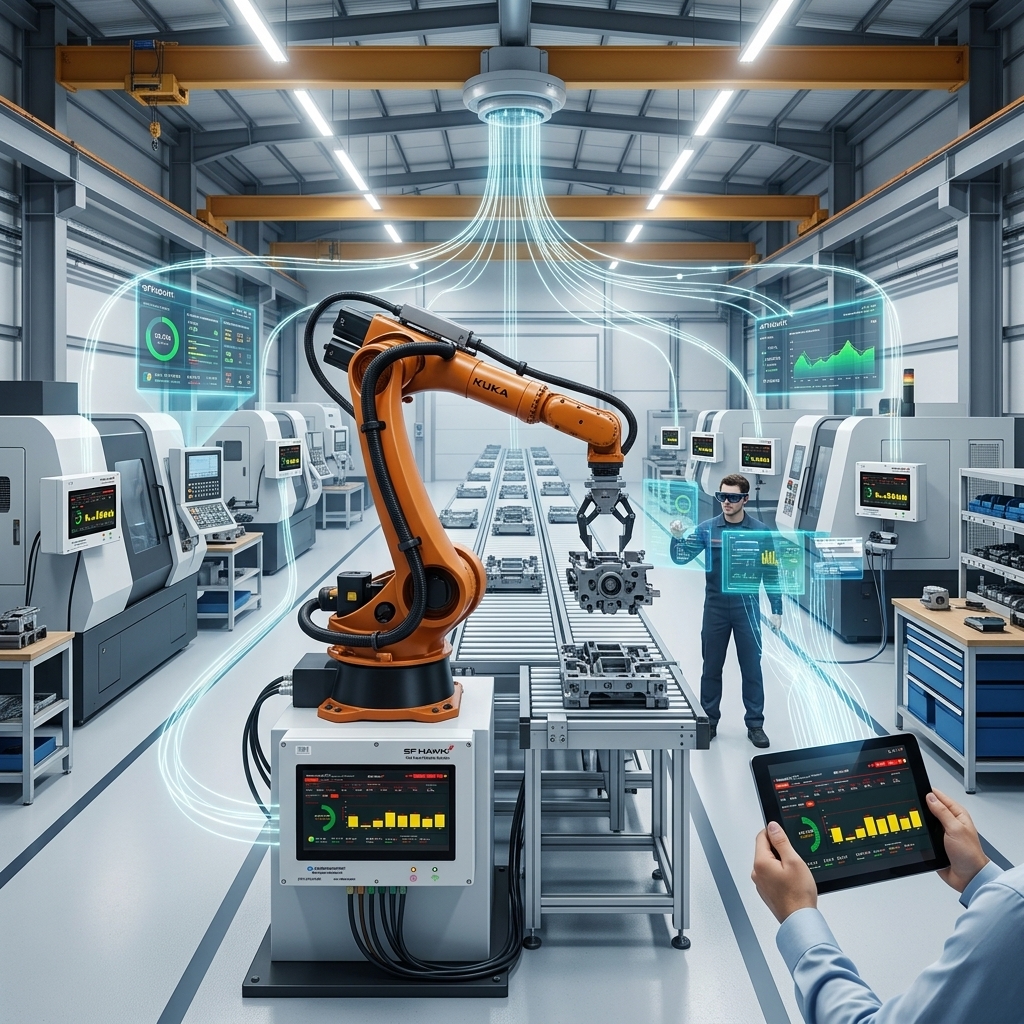
sfHawk‘s Vajra Lite connects through PLC, MTConnect, OPC UA, IO and serial interfaces, over Ethernet or Wi-Fi, and buffers data at the edge so a network drop does not lose production data. Where no direct data connection exists, sensors can be used instead. The result is one data layer for machine monitoring software, however each machine communicates. OPC UA is one way in, not the only one.
Frequently Asked Questions
Is OPC UA a protocol?
It includes a communication protocol, but it is better described as an interoperability standard. IEC 62541 covers transport, security, services and information modeling together.
Does OPC UA require the internet?
No. It runs on local networks and between machines on the plant floor. Internet connections only come into play if you choose to send data to a cloud service.
How is OPC UA different from classic OPC?
Classic OPC, including OPC DA, relied on Microsoft COM and DCOM and ran on Windows. OPC UA is platform independent, has security built in, and supports a richer data model.
Reference: OPC Foundation, OPC UA technology overview and the OPC 10000 specification series; IEC 62541.
Related Reading
Connectivity is only the first step; the value comes from what you do with the data. See how machine monitoring software turns machine signals into run, stop and alarm states by machine, and read about smart factory and Industry 4.0 monitoring for the wider picture. For more detail, read CNC Machine Monitoring: A Complete Guide and What Is Machine Monitoring Software?
Get Started Today! Book a call with sfHawk | Email: inquiry@sfhawk.com | Phone: +91 91120 98351 | Website: www.sfhawk.com